Beyond GPUs: AI Data Centers Are Bringing Liquid Cooling to Optical Transceivers


Another component in AI data centers is approaching the limits of air cooling: optical transceivers. Liquid cooling in data centers has traditionally focused on CPUs, GPUs and server cold plates. But as AI cluster networking moves from 800G to 1.6T and eventually 3.2T, the power consumption and thermal output of the optical transceivers connecting these GPUs are also rising rapidly.
Liquid cooling is now beginning to extend beyond compute hardware and into the networking layer. Recently, liquid cooling specialist CoolIT Systems and fluid connection technology provider Stäubli unveiled a direct-to-plug liquid cooling solution for next-generation pluggable optical transceivers. Optical communications company Ciena collaborated on the design.
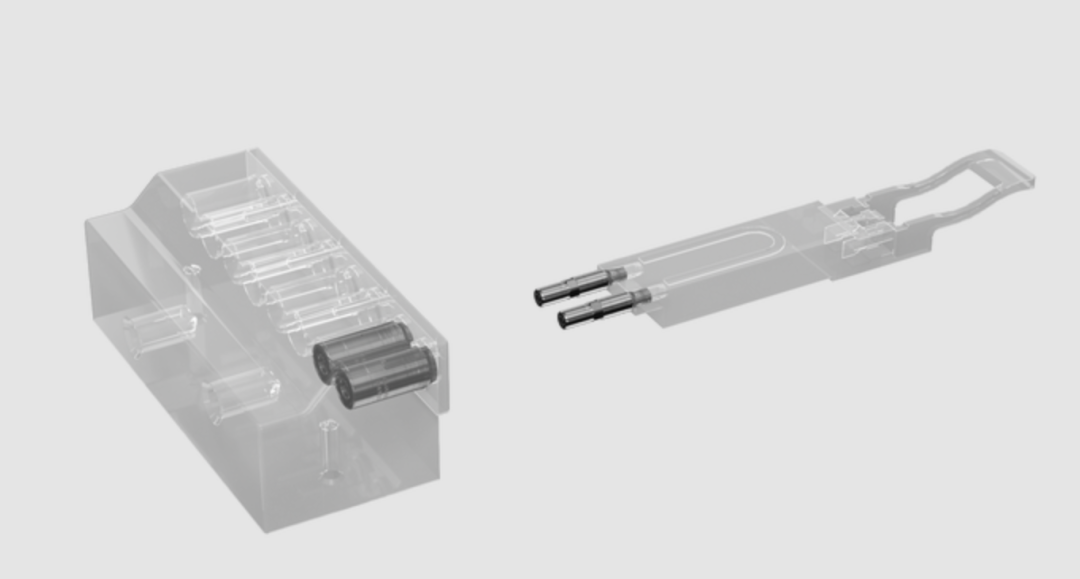
The architecture combines two key components: Stäubli's Mini QD miniature quick-disconnect couplings and CoolIT's dedicated CP-OSFP cold plate.
Together, they enable coolant to flow into and out of pluggable OSFP modules, transferring heat from the transceivers to the system's liquid cooling loop while preserving the convenience of installing, removing and servicing the modules.
Why Optical Transceivers Need Liquid Cooling
As GPU clusters grow in size and processing power, the volume of data exchanged between GPUs increases, driving demand for greater network bandwidth. But the available space on a switch's front panel does not expand with it.
According to CoolIT, a typical 1RU device can accommodate approximately 32 OSFP ports. As optical transceivers become faster and consume more power, they must still fit into an increasingly thermally constrained space on the front panel.
At this point, the challenge is no longer simply whether fans can spin faster. It is whether conventional air cooling can continue to remove heat effectively within such a limited footprint.
CoolIT says high-power coherent pluggable optical transceivers are approaching the practical limits of air cooling. The new solution is designed with not only 800G and 1.6T optics in mind, but also next-generation transceivers operating at 3.2T and beyond.
Two Small Components Bring Liquid Cooling to Optical Modules
The first key component is Stäubli's Mini QD. QD stands for quick disconnect, a coupling that allows fluid lines to be connected and disconnected. However, optical modules offer very little space for additional hardware, while switch front panels must accommodate densely packed ports. Conventional liquid cooling connectors can therefore be difficult to integrate.
Stäubli's Mini QD is designed to provide coolant inlet and outlet connections for OSFP modules while minimizing its footprint. Beyond size, the coupling must also deliver reliable sealing and support serviceability, allowing optical modules to be installed, removed and maintained without compromising the cooling connection.
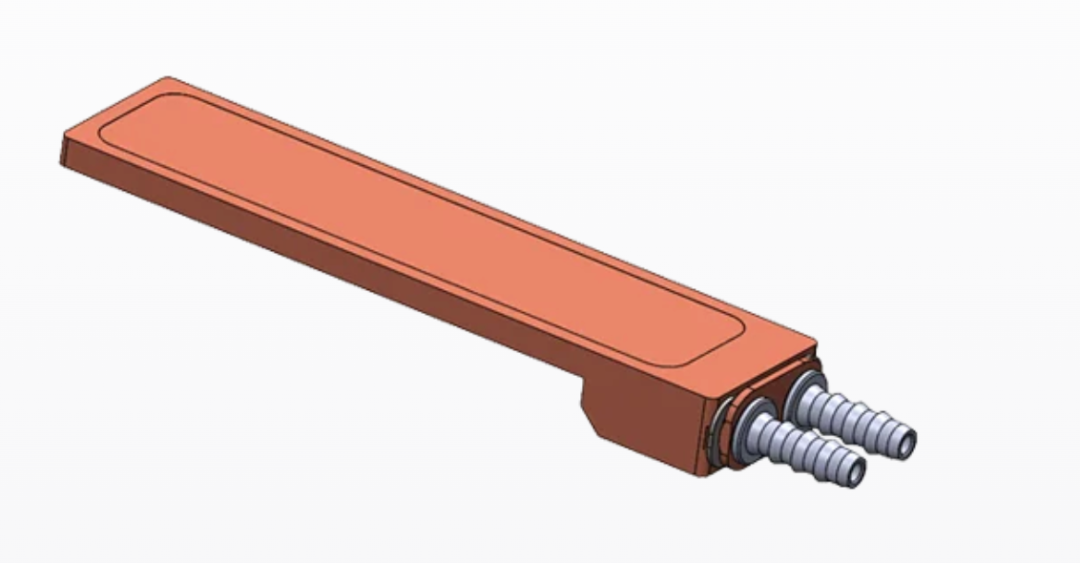
The second component is CoolIT's CP-OSFP cold plate. Unlike the larger cold plates typically used to cool CPUs and GPUs, the CP-OSFP is specifically designed around the form factor and thermal requirements of optical transceivers. It transfers heat from the module into the data center's liquid cooling loop.
Importantly, liquid cooling an optical transceiver does not mean coolant comes into direct contact with the optical chips. Instead, the coolant circulates through sealed cold plates and internal flow channels, carrying heat away from the module. The significance of the architecture goes beyond heat removal alone.
Liquid-Cooled Pluggable Optics Versus Co-Packaged Optics
For next-generation high-power optical modules, the industry is exploring two broad development paths. One is to bring optical components closer to the switching chip through technologies such as co-packaged optics (CPO). The other is to retain pluggable optical transceivers on the switch front panel while using liquid cooling to support higher power consumption and bandwidth.
Liquid-cooled pluggable optics offer an important practical advantage: they preserve the ability to install, remove and replace transceivers individually, without requiring a fundamental shift away from the pluggable form factor. This is not an entirely new approach. Ciena has previously demonstrated direct-to-plug liquid cooling architectures at multiple OCP events.
The latest announcement brings the concept into a more specific hardware configuration by combining Stäubli's Mini QD couplings with CoolIT's CP-OSFP cold plate. That also explains why a component as small as a quick-disconnect coupling can play such a critical role. Without a sufficiently compact, reliable and serviceable fluid interface, even an effective cold plate could be difficult to deploy in a high-density switching system.
Liquid Cooling Is Expanding Beyond Compute Hardware
The boundaries of liquid cooling in AI data centers are shifting once again. Historically, liquid cooling has centered on CPUs and GPUs. Its potential reach is now expanding across servers, memory, storage, power equipment and networking systems—and even down to individual pluggable optical transceivers.
If direct-to-plug cooling gains wider adoption, the data center liquid cooling ecosystem could extend further into smaller components and more granular system architectures. Micro cold plates, miniature quick disconnects, module-level tubing, leak detection and standardized fluid interfaces could all become areas of incremental demand.
However, the announcement should not yet be interpreted as evidence of large-scale commercial deployment. The companies' announcement did not disclose detailed thermal performance figures, coolant flow rates, pressure drop, connection cycle life, system costs, mass-production timelines or specific customer deployments.
For now, the solution is better viewed as a cooling architecture being developed in anticipation of next-generation optical transceivers operating at 3.2T and beyond. As high-power optical modules leave less thermal headroom for air cooling, liquid cooling is likely to push further into the networking stack.
The next growth opportunity in data center liquid cooling may not necessarily be a larger coolant distribution unit (CDU). It could be a much smaller component: a miniature fluid coupling.
Featured News
All News →
Australia Adds 276,000 Home Batteries as Uptake Outpaces AEMO Planning Assumptions
Australia added 8.7 GWh of home battery capacity in the first half of 2026. As installations accelerate, product portfolios, sales channels and subsidy rules are also reshaping access to the market.
Sungrow's EnerNeo SST Reaches Commercial Deployment, Appears in NVIDIA's OCP Showcase
Sungrow's EnerNeo SST has moved from product launch to commercial delivery and operation under real computing loads in under 100 days. At the 2026 OCP Global Summit, its core modules appeared in the NVIDIA MGX AI Factory Ecosystem zone, while new TÜV Rheinland certifications marked another step towards deploying its 800 VDC power architecture across European and North American markets.

Europe's New Sodium-Ion Home Battery: 30,000 Cycles and Discharge Down to -40°C
Bulgarian company AuroraCell has introduced a 9.3 kWh low-voltage sodium-ion home battery for the European market, offering up to 30,000 cell-level cycles, discharge operation down to -40°C and expansion to 139.5 kWh through parallel installation. While its NCO chemistry shows potential advantages in cycle life, thermal stability and cold-weather operation, the headline claims remain subject to specified test conditions and require further third-party and system-level validation.
CATL TENER Sodium Moves Deeper into Europe with Intilion and Merus Power
Europe's sodium-ion BESS market is beginning to move from product launch to system integration. Energy-Storage.news reported that Germany-based Intilion has tied up with CATL to realise sodium-ion BESS projects in the DACH region, targeting up to 3 GWh, while Finland's Merus Power is working on technical integration between its PCS solution and CATL's sodium-ion BESS platform. The latest moves follow CATL's 5 GWh sodium-ion storage partnership with Alfen in July and the launch of its TENER Sodium system in Munich in June, suggesting that European integrators are preparing for sodium-ion storage before the technology becomes fully mainstream.
Envision Gen 8 Completes 64 MWh Site Level Fire Test
Envision has announced a 64 MWh site-level fire test of its Gen 8 AI energy storage system under 5 cm spacing, 100% SOC and disabled active protection systems.
First 106 Units Shipped! HiTHIUM’s Shandong Heze Base Begins Large-Scale Overseas Deliveries of LDES
Source: HiTHIUM Recently, the Shandong HiTHIUM Long-Duration Energy Storage Integrated Industrial Park (Shandong Heze Base) marked its first international export since commencing mass production. The initial shipment—comprising 106 units of the ∞Power 6.25MWh 4-hour long-duration energy storage system prefabricated…
Exclusive: Sungrow Launches All-in-One PowerHarbor, Betting Benelux Home Storage Is Just Beginning
Rooftop solar is already widespread among Dutch households, yet relatively few homes have installed residential energy storage. Sungrow believes this market is only just beginning. On September 22, Sungrow held an event in Amsterdam to officially launch its PowerHarbor all-in-one residential energy storage system in…
Eternalplanet Raises Hundred-Million-Yuan Funding for Global Residential Storage Expansion
Source: Eternalplanet Recently, Shenzhen Eternalplanet Energy Co., Ltd. (hereinafter referred to as Eternalplanet) has successfully closed a financing round of hundreds of millions of RMB. Led by ZX Holdings, the raised funds will be mainly used for new product R&D, global market expansion and supply chain…