Envision Energy has announced the completion of a 64 MWh site-level fire test involving its latest-generation Gen 8 AI energy storage system. The company described the exercise as the largest site-level fire test yet conducted in the energy storage industry. The test was designed to evaluate fire resistance, thermal isolation and propagation control under conditions intended to represent an extreme failure scenario at a large-scale battery storage site. According to information released by Envision, CSA Group led the test design and on-site execution, while a US-registered fire protection engineer witnessed the process.
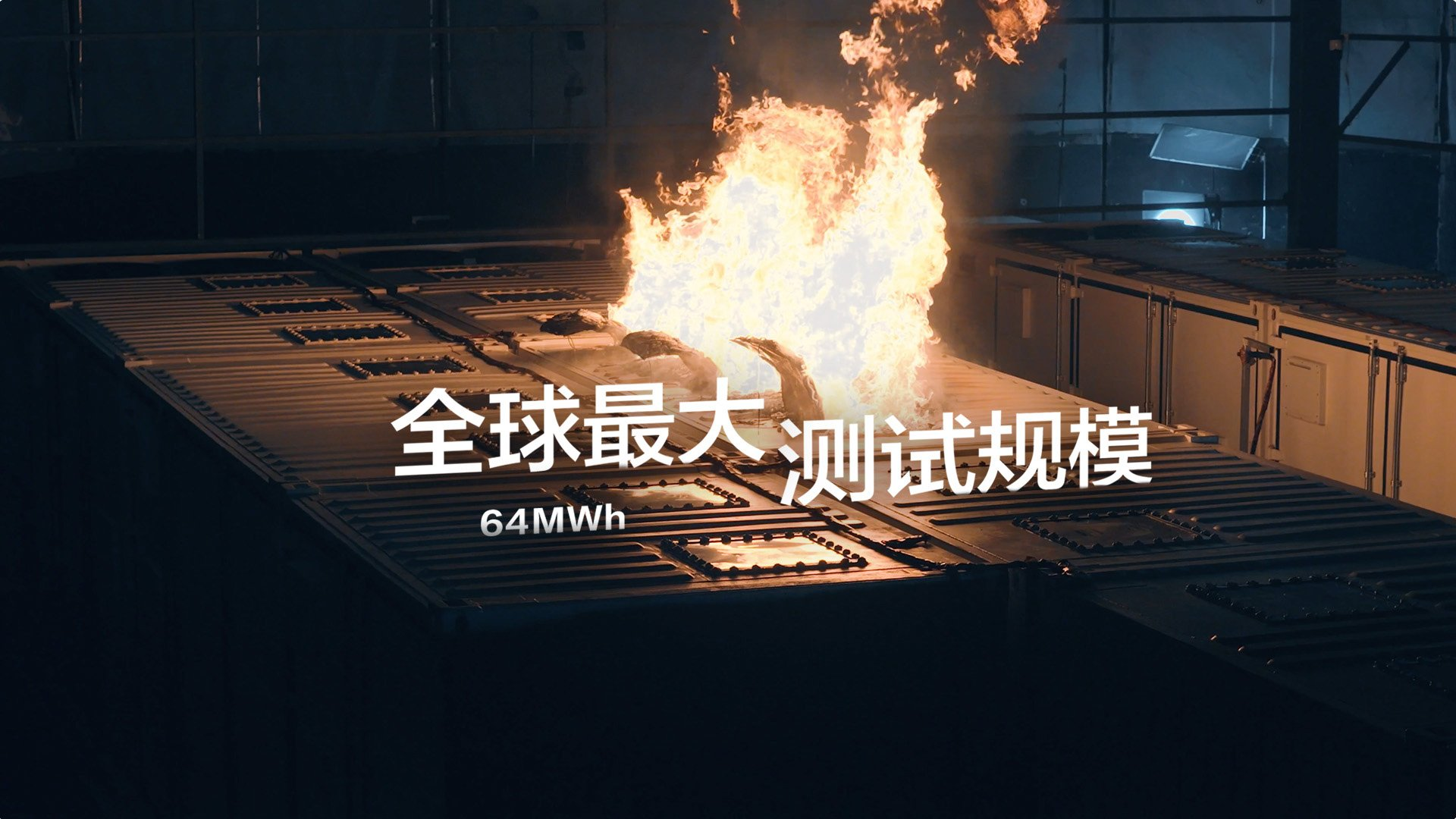
The Gen 8 system during the fire test. Image: Envision test material published by Battery Network.
Four 16 MWh systems tested together
The test configuration comprised four 16 MWh energy storage systems, bringing the total capacity under evaluation to 64 MWh. The units were arranged in an A-D configuration to examine whether a fire originating in one part of the array could propagate to neighbouring DC systems or associated AC equipment.
The accompanying test material identifies each DC unit at 16 MWh. The systems used Envision large-format wound prismatic cells, described in the announcement as 700+ Ah cells. One supporting visual identifies the tested cell specification as 790 Ah.
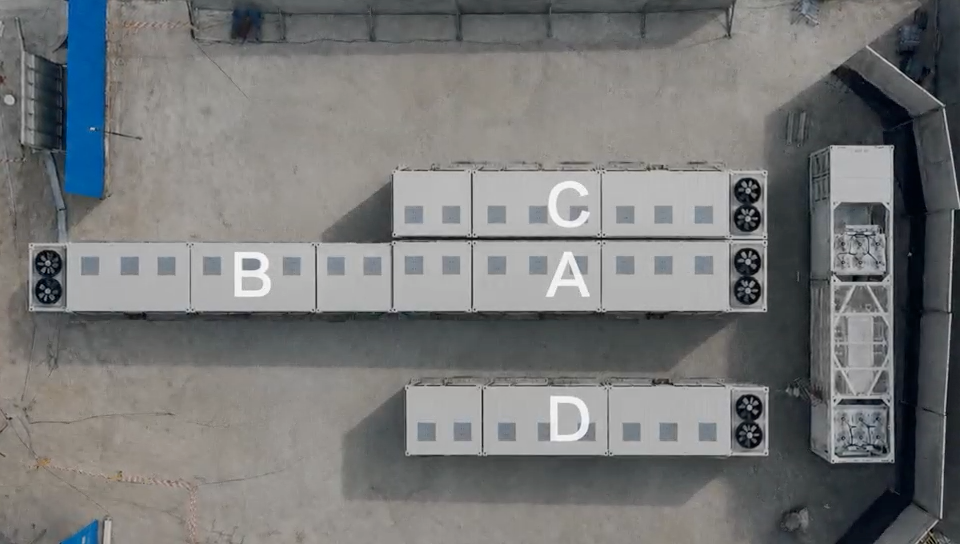
The four test systems were identified as units A, B, C and D. Image: Envision test material published by Battery Network.
Full charge high temperature and 5 cm spacing
Envision said the systems were tested at 100% state of charge and under high-temperature conditions. The distance between adjacent systems was reduced to 5 cm, with no additional heat-dissipation corridor between the enclosures. This placed neighbouring systems under sustained thermal radiation during the fire.
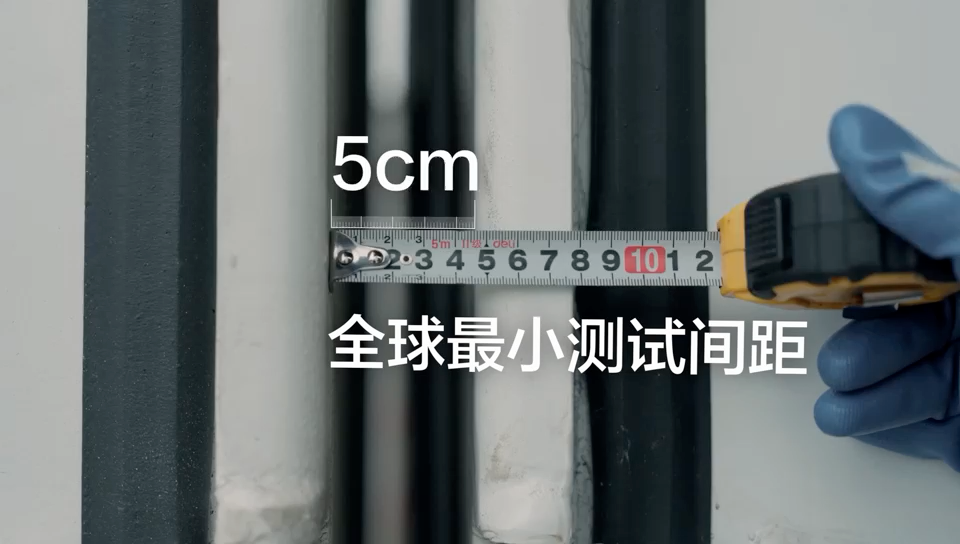
The test systems were positioned 5 cm apart. Image: Envision test material published by Battery Network.
The company also said the warning, detection, control and fire-suppression systems were disabled. The purpose was to assess passive fire protection, structural integrity and thermal isolation in a scenario where active protection measures were unavailable. The test was conducted with reference to NFPA 855 and UL 9540A, according to the announcement.
Fire reached 1218 degrees Celsius
Envision reported that the overall test lasted 49 hours. Open flames continued for nine hours before extinguishing without external intervention. At the height of the fire, the reported temperature reached 1,218 degrees Celsius and peak heat release exceeded 1,500 kW.
The company reported the following results:
· No thermal propagation occurred between adjacent DC systems.
· No propagation occurred from the DC equipment to the AC equipment.
· No explosion or flying debris was observed.
· The main test enclosure showed no structural deformation or melt-through.
· The enclosure doors remained operable following the test.
· The high-voltage box remained powered throughout the test.
· Cell temperatures inside adjacent enclosures remained below 50 degrees Celsius.
· The neighbouring systems showed no significant internal damage.
Envision attributed the result to safety measures implemented at cell, pack and system levels, including cell material and structural design, thermal insulation between packs, reinforced enclosure protection and directional thermal barriers.
NFPA 855 and UL 9540A serve different purposes
Although the two standards are frequently mentioned together, NFPA 855 and UL 9540A are not interchangeable. NFPA 855 is an installation standard addressing the deployment and fire-safety requirements of stationary energy storage systems. UL 9540A is a test method used to evaluate thermal runaway and fire propagation at cell, module, unit and installation levels. The accurate wording in this case is that the test was conducted with reference to NFPA 855 and UL 9540A. This should not be interpreted as an NFPA certification or as confirmation that a complete UL 9540A test report has been publicly released.
Large systems raise the bar for safety validation
As the capacity of individual cells and energy storage systems increases, safety evaluation is expanding beyond cell- and enclosure-level testing. Site-level tests can provide additional evidence on enclosure integrity, separation distances, heat transfer between systems and the performance of passive protection measures under project-scale configurations.
Envision said the 64 MWh test was intended to extend safety validation from individual components and enclosures to a multi-system arrangement more representative of large-scale projects.
However, the company has not publicly disclosed the exact test date or location. At the time of publication, the complete CSA test report, detailed temperature and heat-release curves and full test methodology had also not been made publicly available. The results should therefore be presented as data released by Envision pending further third-party technical documentation.