Sungrow reportedly plans to source Samsung SDI cells to ease U.S. supply-chain pressure


On September 9, ESS News, citing a person familiar with the matter, reported that Sungrow plans to procure LFP cells from South Korea's Samsung SDI for use in its own energy storage systems, with one of the main goals being to support continued deliveries to the U.S. market. According to the report, the two companies are moving forward with the cooperation, with a potential agreement lasting three years and annual supply reaching several GWh. However, procurement volumes, contract value, manufacturing locations and delivery arrangements have not been disclosed, and neither Sungrow nor Samsung SDI had formally commented at the time of publication.
At first glance, this may look like Sungrow is simply adding another battery supplier. But against the backdrop of tighter U.S. scrutiny of China-linked clean energy supply chains, the move looks more strategic. Sungrow may be trying to separate its strengths in PCS, EMS and system integration from the sourcing of battery cells, using non-Chinese — and potentially U.S.-made — cells to reduce uncertainty around supply-chain compliance and market access for U.S. projects.
Why a decade-old partnership matters again
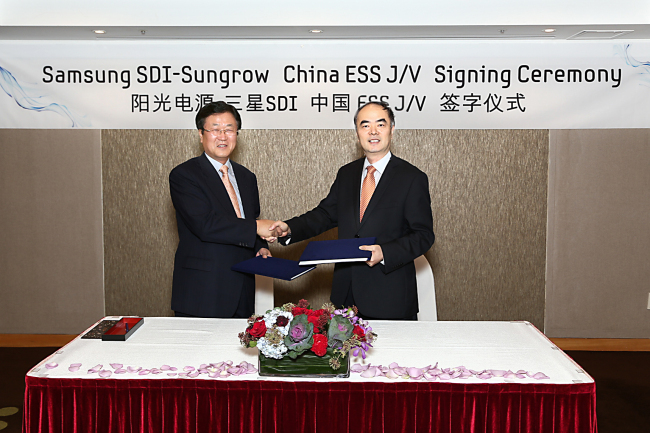
Samsung SDI and Sungrow are not new partners. According to previous public announcements from both companies, they signed an ESS joint venture agreement as early as 2014 and formally launched Sungrow-Samsung SDI Energy Storage Power Supply Co., Ltd. in Hefei in 2016. The roles were clear: Samsung SDI provided lithium-ion battery technology, while Sungrow contributed PCS and EMS capabilities. The joint venture was established to deliver complete energy storage solutions, with planned annual production capacity of up to 2 GWh. The partnership later also participated in large-scale energy storage projects in Japan.
What has changed is the market environment. U.S. restrictions on China-linked energy supply chains are moving beyond import costs and increasingly touching equipment origin, local manufacturing and compliance for key components. Reuters reported in June that the U.S. government was considering new restrictions on foreign-made energy inverters, with Chinese suppliers among the main targets; by August, additional restrictions had also been introduced for certain foreign grid equipment.
Why does this matter so much to Sungrow? Its business mix gives a clear answer. According to Sungrow's 2025 annual report, overseas revenue reached around RMB 54 billion, accounting for more than 60% of total revenue. Energy storage systems contributed roughly RMB 37.3 billion, or about 42%, while PV inverters and other power conversion equipment contributed around RMB 31.1 billion, or about 35%.
In other words, storage and inverters together account for more than three quarters of Sungrow's revenue. U.S. restrictions targeting batteries, inverters and other key power electronics are therefore not a peripheral policy issue — they touch two of the company's most important business lines and can directly affect overseas market access, project delivery and supply-chain planning.
That is why Sungrow increasingly needs to think about where cells are made, where upstream materials come from, and whether the overall system can meet local content and compliance requirements. Bringing Samsung SDI back into the picture would not simply mean adding another cell supplier; it could give Sungrow a more controllable supply-chain route for the U.S. market.
Why Samsung SDI fits the need
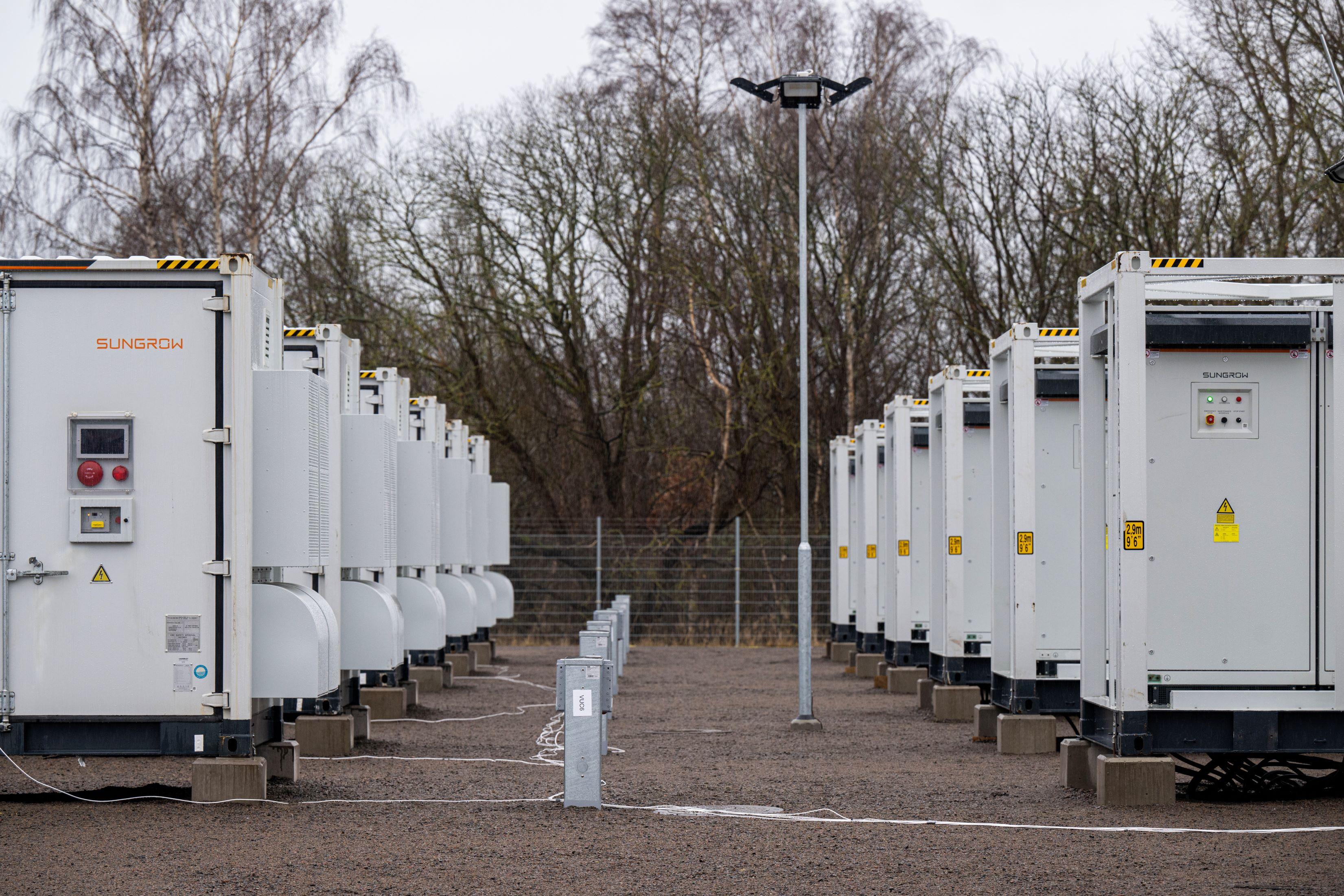
The key is Samsung SDI's current North American ESS strategy. Samsung SDI is converting part of the EV battery production capacity at StarPlus Energy, its Indiana joint venture with Stellantis, toward stationary energy storage. The company plans to begin mass production of prismatic LFP ESS batteries in the fourth quarter of 2026. Samsung SDI's investor materials have also pointed to a target of around 30 GWh of U.S. ESS production capacity by the end of 2026.
At the same time, the company is pushing localization further upstream. In March, Samsung SDI signed an approximately KRW 1.6 trillion agreement with South Korean materials supplier L&F for LFP cathode materials starting in 2027. Those materials are intended for ESS battery production at StarPlus Energy. Samsung SDI said the arrangement is aimed at strengthening its competitiveness in the North American ESS market while reducing dependence on China-linked supply chains.
For Sungrow, that combination — U.S. manufacturing + Korean upstream materials — lines up closely with the localization and compliance pressures it faces in the U.S. market. It is still not confirmed that Samsung SDI's U.S. plants would ultimately supply Sungrow directly, but there is another practical question: Samsung SDI's large-scale shift into ESS is still relatively recent, so can it support the sustained demand of a leading global system supplier like Sungrow?
Samsung SDI's recent order book offers at least one reference point. In March, the company confirmed that its U.S. subsidiary had signed a four-year ESS battery supply contract worth around KRW 1.5 trillion, with plans to transition part of the supply to LFP products manufactured at StarPlus Energy. That does not prove Samsung SDI can meet all of Sungrow's future requirements, but it does show that its North American ESS supply chain is already moving beyond capacity planning and into large-scale commercial delivery.
Sungrow's two-track approach: build in Europe, reshape sourcing in the U.S.
If this potential Samsung SDI deal is viewed in isolation, it can easily look like a simple supplier adjustment. But placed alongside Sungrow's other overseas moves, a broader pattern starts to emerge.
In Europe, Sungrow has chosen a more direct localization strategy. In February, the company announced plans to build its first European manufacturing base in Lower Silesia, Poland, with an investment of around €230 million. The facility is planned to produce 20 GW of inverters and 12.5 GWh of energy storage systems annually, with operations expected to begin in the first quarter of 2027. Sungrow has positioned the plant as part of its effort to strengthen supply-chain resilience in Europe.
In the U.S., Sungrow has not publicly announced a local energy storage manufacturing base, so the more realistic route appears to be reconfiguring the sourcing of key components first. If Samsung SDI ultimately supplies LFP cells from U.S.-based production, Sungrow could retain its own PCS, EMS and system integration capabilities while shifting one of the most sensitive parts of the system — the battery supply chain — toward U.S. and non-Chinese sources.
In other words, Sungrow appears to be adapting its localization strategy market by market: some parts of the supply chain can remain in China, while others need to move closer to the end market or be sourced differently depending on local rules. Europe can be addressed through local manufacturing; the U.S. may require a greater reliance on locally made cells, non-Chinese materials and reconfigured component sourcing.
This shift is not unique to Sungrow. LG Energy Solution, after taking full control of Canada's NextStar Energy plant this year, has also made clear that more of the facility's former EV battery capacity will be redirected toward ESS to serve growing North American demand. Rising storage demand and tighter localization requirements are pushing both battery makers and system suppliers to rethink where production sits and how their supply chains are structured.
For now, the final shape of the Samsung SDI cell deal remains unconfirmed. Until Sungrow or Samsung SDI says more, we will have to wait and see how far this potential supply-chain shift actually goes...
Featured News
All News →
Italy Opens 16GWh Storage Auction Today as Second MACSE Round Expands by 60%
Italy will open its second MACSE energy storage auction on 24 November, procuring up to 16GWh of capacity from new projects scheduled for delivery in 2029. Compared with the first auction, procurement volume has increased by 60%, while the maximum permitted bid has been reduced from €37,000/MWh/year to €27,000/MWh/year. The results will provide a new indication of competition, regional deployment and current cost levels in Italy's energy storage market.

The Real Test Comes When the Grid Goes Down: 1,000 Witness MWh-Scale Diesel–Battery Microgrid Demonstration
A live MWh-scale demonstration at Sungrow GEPS 2026 showcased how battery storage, diesel generation and grid-forming technology can work together to deliver reliable power in off-grid applications. ENERGY PLANET joined the event to explore the technical highlights and their implications for future C&I energy storage projects.

Tesla Launches 7.4MW Powercore: Connecting Batteries Directly to the 34.5kV Grid and Medium Voltage to 800V Data Centres
Tesla has launched Powercore, a solid-state medium-voltage platform integrating transformer, bidirectional inverter and circuit-breaker functions. Rated at 7.4MW, it connects 800V–2,000V DC systems with 10kV–34.5kV AC networks, targeting battery storage, solar and 800V AI data centres. The first units are scheduled to operate in 2027, although Tesla has not disclosed pricing, customers or initial projects.
UPS Moves to the Grid Edge as Vertiv Launches 3 MVA Medium-Voltage System
Vertiv has launched the 3 MVA PowerNexus MV UPS, moving UPS functionality from the indoor low-voltage side to the outdoor 34.5kV grid connection point. Designed for new and expanding AI data centres, the system integrates fault ride-through, AI load smoothing, power-quality control and one-to-four-hour battery backup. Following a proof-of-concept demonstration in Bologna, commercial shipments are expected to begin in mid-2027.

Envision Gen 8 Selected for 442 MWh Grid Forming BESS in Germany Taking Partnership Close to 600 MWh
Envision Energy and German storage developer ju:niz Energy are advancing the 442 MWh Smareg 13 project in Bavaria. The four-hour, grid-forming development is planned next to the operational Smareg 12 site, while public records currently show a 100 MW/401 MWh configuration and a March 2028 target date.

CATL Delivers First 8-Hour EnerQB Systems for Quinbrook's 24GWh Australian Pipeline
CATL and Quinbrook Infrastructure Partners have completed production and delivery of the first EnerQB long-duration energy storage systems. Designed for eight-hour discharge, the initial units will undergo a 12-month trial at Stanwell Power Station in Queensland, Australia. Quinbrook has identified a potential 3GW/24GWh project pipeline, although wider deployment will depend on trial results, financing, grid connections and subsequent procurement.

1.24GWh! Sungrow Supplies Europe's Largest Operational Energy Storage Project
BW ESS’s Hams Hall project in the UK has officially brought its first phase online, with 350MW/1.243GWh of capacity, making it the largest operational battery storage project in Europe. Sungrow supplied the BESS, with Energy-IO and other partners involved in project delivery. The project also secured a 10-year optimisation agreement with EDF, debt financing from international banks and equity investment from AIP, highlighting the full value chain behind Europe’s GWh-scale storage projects, from equipment supply and project delivery to commercial operations and financing.

BNEF's Q4 Energy Storage Tier 1 List Shrinks 26% to 50 Manufacturers
BloombergNEF has named 50 manufacturers to its Q4 2026 Tier 1 Energy Storage list. Based on publicly available company disclosures, Energy Planet has confirmed 19 of the manufacturers and compiled historical inclusion records for 12 of them. While a single appearance shows that a supplier met the criteria for that quarter, repeat inclusion offers a stronger indication of its ability to maintain a pipeline of qualifying projects. Tier 1 remains a measure of market adoption, however, rather than a product-quality ranking, corporate credit rating or substitute for project-level technical and financial due diligence.