Saudi Arabia Signs 6 GWh of Four-Hour Energy Storage Projects


An energy storage development that first came into market view as "SPPC securing a 6 GWh order in the Middle East" is now taking on a more complete shape as multiple participants disclose further information.
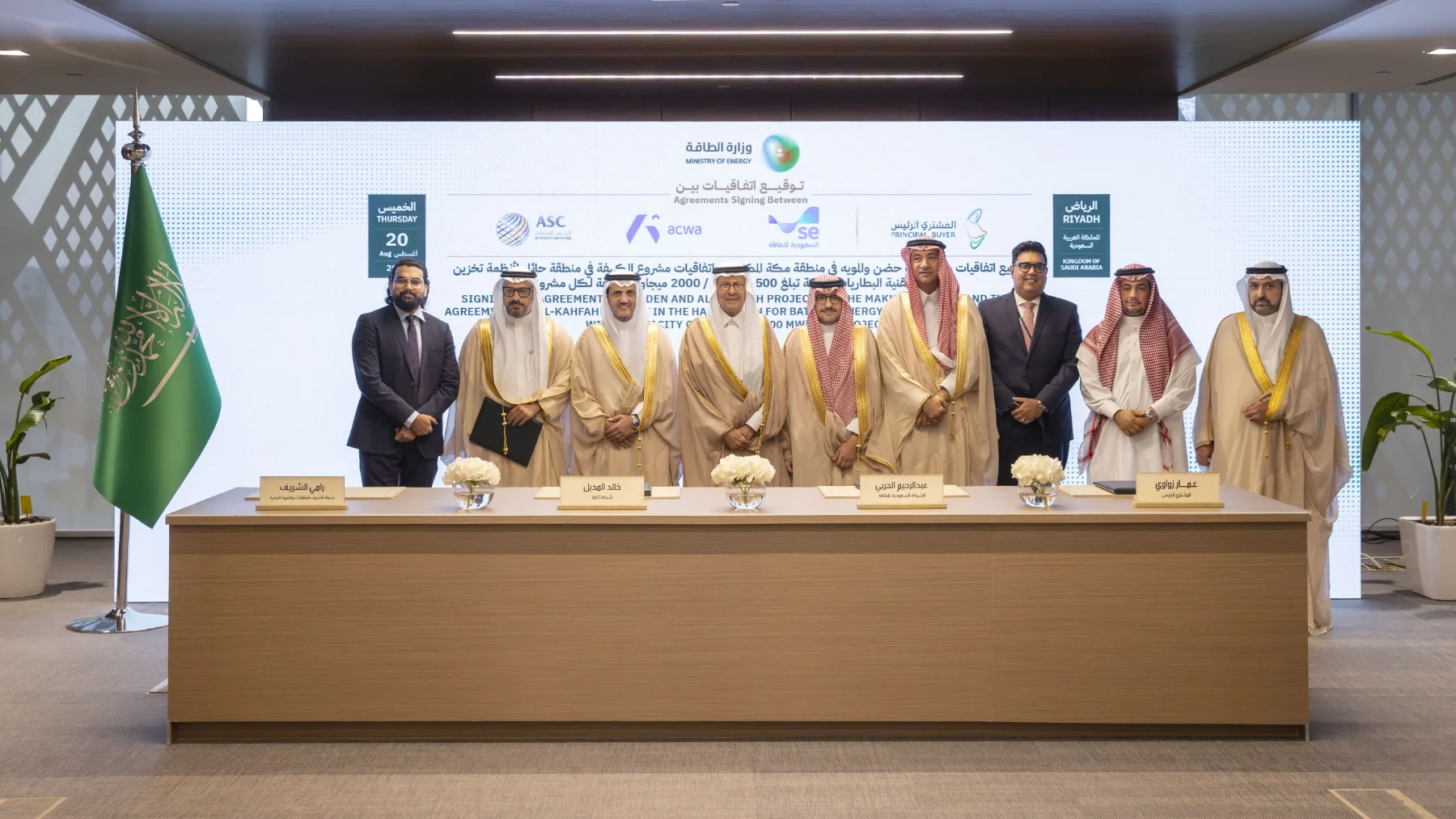
On August 20, the Saudi Power Procurement Company (SPPC) signed energy storage service agreements with three project companies for the Haden, Al-Muwaih and Kahafah independent energy storage projects. Each project has a capacity of 500 MW/2,000 MWh, bringing the combined capacity to 1.5 GW/6 GWh. All three projects have a four-hour storage duration. Haden and Al-Muwaih are located in Makkah Province, while Kahafah is located in Ha'il Province.
The projects will be developed under a build-own-operate (BOO) model. The energy storage service agreements have a term of 15 years from the respective commercial operation dates, with a combined disclosed value of SAR 3.25 billion. In terms of ownership, Saudi Energy holds an effective 35.1% interest in each project, while ACWA Power will hold 34.9% upon financial close. Public award information also identifies Al Sharif Contracting and Commercial Development as a consortium member, although its final ownership percentage has not yet been disclosed.
Project Participants and the Boundaries of Their Responsibilities
Under this structure, SPPC organizes the tender process and procures energy storage capacity and services from the project companies on a long-term basis. ACWA Power, Saudi Energy and Al Sharif participate in project development, while three special-purpose project companies are responsible for financing, construction, asset ownership, operation and long-term contractual performance.
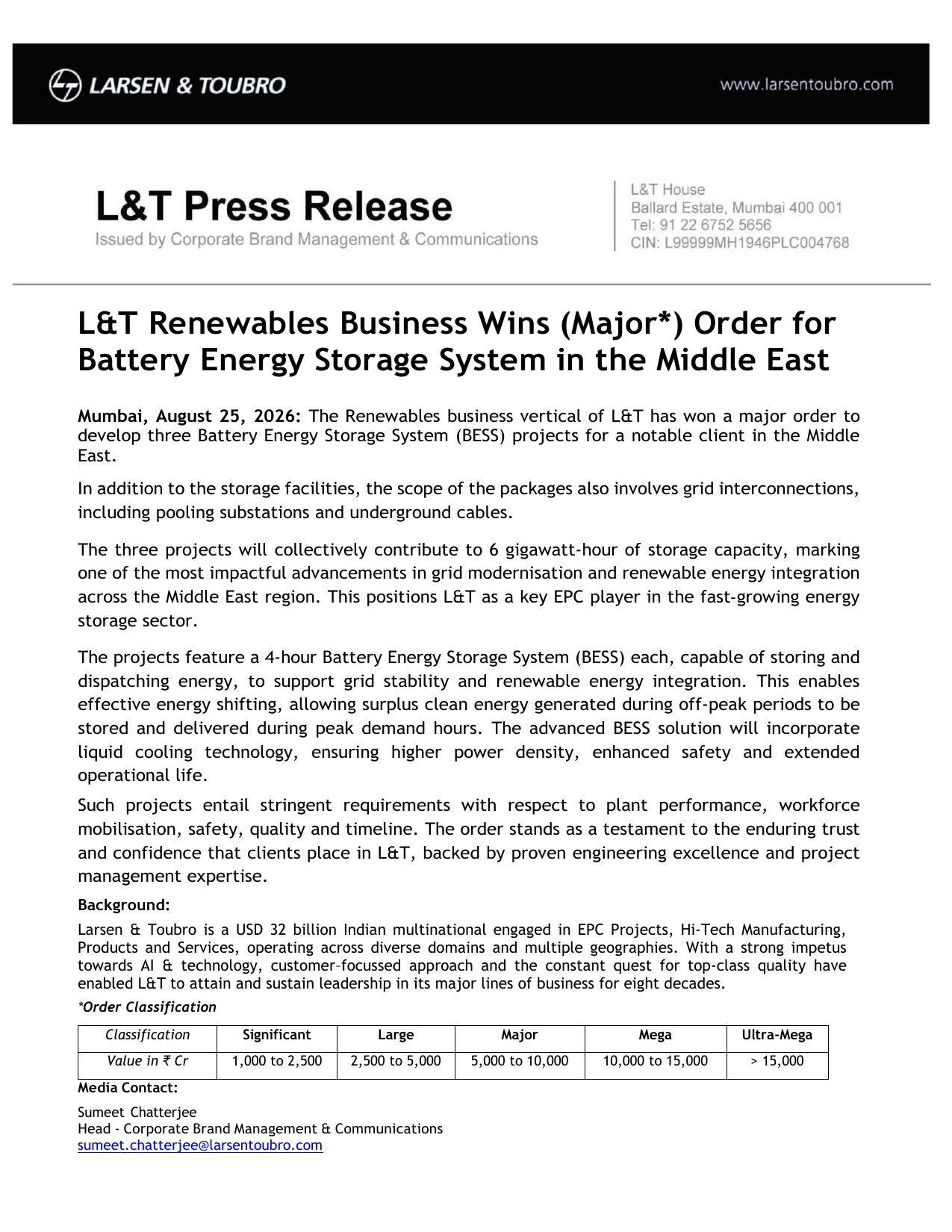
On August 25, Larsen & Toubro (L&T) announced that it had secured orders for three four-hour energy storage projects in the Middle East with a combined capacity of 6 GWh. The disclosed scope includes battery energy storage facilities, pooling substations, underground cabling and grid connections, with liquid-cooling technology to be adopted.
Based on the number of projects, capacity, storage duration and engineering scope, the L&T order closely matches the three Saudi projects described above. The Haden project's inclusion of a 380 kV substation expansion and associated grid-connection works provides further support for this correspondence.
However, the parties have not identified one another in their respective announcements. L&T has not disclosed the customer or project names, while SPPC, ACWA Power and Saudi Energy have not publicly identified L&T. The more accurate formulation is therefore that L&T's order is highly likely to correspond to the Haden, Al-Muwaih and Kahafah projects, although this remains a cross-assessment based on publicly available information rather than a relationship formally confirmed by both sides.
L&T can be placed on the engineering execution side, but it remains unclear whether the company is responsible for the full EPC scope. The suppliers of the battery cells, BESS, power conversion systems and control platforms have also not been disclosed.
The SAR 3.25 billion announced by Saudi Energy cannot be directly compared with L&T's "Major" order classification. The former reflects the value of the projects or energy storage service agreements, while the latter is an internal classification of the engineering orders secured by L&T. The two figures therefore cover different contractual boundaries.
The core of this structure is not a one-off equipment purchase, but the continuous provision of services over 15 years. Under the BOO model, the project companies must assume long-term responsibility for system availability, capacity retention and operating performance. Project evaluation therefore extends beyond initial construction costs to performance across the full asset lifecycle.
Why All the Projects Use Four-Hour Storage
The three projects have a combined storage capacity of 6 GWh. Based on a four-hour storage duration, this corresponds exactly to an output capacity of 1.5 GW.
Unlike short-duration storage systems primarily used for rapid frequency regulation, four-hour systems are better suited to intraday energy shifting. During the daytime, when solar generation is concentrated, the storage systems can absorb part of the electricity produced. When solar output declines in the evening while power demand remains high, they can continue discharging for several hours.
This is directly related to changes in Saudi Arabia's power structure. As solar and wind capacity expands, the electricity system requires more flexible resources capable of bridging the evening supply-demand gap. Rising air-conditioning demand under high-temperature conditions further increases the need for capacity support during evening hours.
The four-hour configuration is not unique to these three projects. It is becoming a standard design for Saudi Arabia's independent energy storage program. The country's first batch comprises four independent storage projects with a combined capacity of 2 GW/8 GWh, all based on the same 500 MW/2,000 MWh configuration.
In addition to the three projects covered here, which total 6 GWh, the first batch includes the Al-Khushaybi project being developed by a consortium of ENGIE and Haji Abdullah Alireza. That project also has a capacity of 500 MW/2,000 MWh.
SPPC's subsequent second batch follows the same design. It comprises six projects with a combined capacity of 3 GW/12 GWh, with each project again configured at 500 MW/2,000 MWh. Together, the two batches form an independent energy storage procurement pipeline of 5 GW/20 GWh.
When multiple projects adopt the same power capacity, storage duration and broadly similar development model, Saudi Arabia's energy storage market is moving beyond individual project experimentation toward a standardized procurement framework that can be replicated at scale.
The Middle East Market Opportunity Behind the 6 GWh Projects
For the energy storage supply chain, the message from these projects extends beyond an additional 6 GWh of potential equipment demand.
First, energy storage in the Middle East is moving away from projects attached to solar plants or off-grid applications and toward large-scale infrastructure that participates independently in power system operations. Long-term energy storage service agreements provide projects with stable revenue and create a foundation for project financing.
Because developers must assume responsibility for system performance over the next 15 years, the cycle life, degradation performance and long-term service capabilities of equipment suppliers are becoming increasingly important.
Second, the boundary between energy storage facilities and grid infrastructure is becoming increasingly integrated. L&T's disclosed scope covers not only the storage facilities but also pooling substations, underground cabling and grid-connection works. The Haden project also includes the expansion of a 380 kV substation.
For projects at the scale of several GWh, the ability to complete high-voltage grid connection on schedule is becoming just as important as the energy storage system itself.
The projects also show that conditions in the Middle East are raising the threshold for equipment suppliers seeking market entry. L&T has confirmed the use of a liquid-cooling solution, but liquid cooling represents only one component of the overall technical system.
High temperatures, dust and prolonged operation under heavy loads will also test battery-cell degradation, system derating, safety protection, fire-protection design and capacity augmentation arrangements. Equipment suppliers competing for these projects face more than price competition: they must also demonstrate long-term warranty capabilities, an international project track record, bankability and local service capacity.
The suppliers of the battery cells, energy storage systems, power conversion systems and control platforms for the three projects have not yet been disclosed. The contractual relationship between L&T and the development consortium also remains subject to formal confirmation.
These will be the most important points to watch in the next stage. They will determine which companies ultimately receive orders associated with the 6 GWh projects and reveal how Saudi Arabia's large-scale energy storage developments balance technology, pricing and localization capabilities.
From the signing of the first 8 GWh batch to the launch of the second 12 GWh batch, Saudi Arabia is incorporating four-hour energy storage into its long-term power system development framework.
For the industry, the central question is no longer how many GWh any single company has secured. What matters is which companies can enter this long-term project structure and assume full responsibility—from equipment delivery and grid connection to operational performance over many years.
Sources:
1. ACWA Power — Agreements for 6,000 MWh of Battery Storage in Saudi Arabia
https://www.acwapower.com/en/media-center/latest-news/acwa-signs-agreements-for-6-000-mwh-of-battery-storage-in-saudi-arabia/
2. Saudi Exchange — ACWA Power's Disclosure on the Storage Services Agreements
https://www.saudiexchange.sa/wps/portal/saudiexchange/newsandreports/issuer-news/issuer-announcements/issuer-announcements-details/?anCat=1&anId=97727&cs=2082&locale=en
3. Saudi Exchange — Saudi Energy's Disclosure on the Haden BESS Project
https://www.saudiexchange.sa/wps/portal/saudiexchange/newsandreports/issuer-news/issuer-announcements/issuer-announcements-details/?anCat=1&anId=97738&cs=5110&locale=en
4. L&T — Official Announcement on the 6 GWh Middle East BESS Order
Publicly accessible report reproducing the announcement:
https://www.nbmcw.com/news/energy-power/l-t-renewables-business-wins-major-order-for-battery-energy-storage-system-in-the-middle-east.html
5. Saudi Press Agency — SPPC's Second Group of 12,000 MWh Battery Energy Storage Projects
https://www.spa.gov.sa/en/N2568317
Featured News
All News →
Italy Opens 16GWh Storage Auction Today as Second MACSE Round Expands by 60%
Italy will open its second MACSE energy storage auction on 24 November, procuring up to 16GWh of capacity from new projects scheduled for delivery in 2029. Compared with the first auction, procurement volume has increased by 60%, while the maximum permitted bid has been reduced from €37,000/MWh/year to €27,000/MWh/year. The results will provide a new indication of competition, regional deployment and current cost levels in Italy's energy storage market.

The Real Test Comes When the Grid Goes Down: 1,000 Witness MWh-Scale Diesel–Battery Microgrid Demonstration
A live MWh-scale demonstration at Sungrow GEPS 2026 showcased how battery storage, diesel generation and grid-forming technology can work together to deliver reliable power in off-grid applications. ENERGY PLANET joined the event to explore the technical highlights and their implications for future C&I energy storage projects.

Tesla Launches 7.4MW Powercore: Connecting Batteries Directly to the 34.5kV Grid and Medium Voltage to 800V Data Centres
Tesla has launched Powercore, a solid-state medium-voltage platform integrating transformer, bidirectional inverter and circuit-breaker functions. Rated at 7.4MW, it connects 800V–2,000V DC systems with 10kV–34.5kV AC networks, targeting battery storage, solar and 800V AI data centres. The first units are scheduled to operate in 2027, although Tesla has not disclosed pricing, customers or initial projects.
UPS Moves to the Grid Edge as Vertiv Launches 3 MVA Medium-Voltage System
Vertiv has launched the 3 MVA PowerNexus MV UPS, moving UPS functionality from the indoor low-voltage side to the outdoor 34.5kV grid connection point. Designed for new and expanding AI data centres, the system integrates fault ride-through, AI load smoothing, power-quality control and one-to-four-hour battery backup. Following a proof-of-concept demonstration in Bologna, commercial shipments are expected to begin in mid-2027.

Envision Gen 8 Selected for 442 MWh Grid Forming BESS in Germany Taking Partnership Close to 600 MWh
Envision Energy and German storage developer ju:niz Energy are advancing the 442 MWh Smareg 13 project in Bavaria. The four-hour, grid-forming development is planned next to the operational Smareg 12 site, while public records currently show a 100 MW/401 MWh configuration and a March 2028 target date.

CATL Delivers First 8-Hour EnerQB Systems for Quinbrook's 24GWh Australian Pipeline
CATL and Quinbrook Infrastructure Partners have completed production and delivery of the first EnerQB long-duration energy storage systems. Designed for eight-hour discharge, the initial units will undergo a 12-month trial at Stanwell Power Station in Queensland, Australia. Quinbrook has identified a potential 3GW/24GWh project pipeline, although wider deployment will depend on trial results, financing, grid connections and subsequent procurement.

1.24GWh! Sungrow Supplies Europe's Largest Operational Energy Storage Project
BW ESS’s Hams Hall project in the UK has officially brought its first phase online, with 350MW/1.243GWh of capacity, making it the largest operational battery storage project in Europe. Sungrow supplied the BESS, with Energy-IO and other partners involved in project delivery. The project also secured a 10-year optimisation agreement with EDF, debt financing from international banks and equity investment from AIP, highlighting the full value chain behind Europe’s GWh-scale storage projects, from equipment supply and project delivery to commercial operations and financing.

BNEF's Q4 Energy Storage Tier 1 List Shrinks 26% to 50 Manufacturers
BloombergNEF has named 50 manufacturers to its Q4 2026 Tier 1 Energy Storage list. Based on publicly available company disclosures, Energy Planet has confirmed 19 of the manufacturers and compiled historical inclusion records for 12 of them. While a single appearance shows that a supplier met the criteria for that quarter, repeat inclusion offers a stronger indication of its ability to maintain a pipeline of qualifying projects. Tier 1 remains a measure of market adoption, however, rather than a product-quality ranking, corporate credit rating or substitute for project-level technical and financial due diligence.