Intersolar Exhibition Flash: This Firm Delivers Tangible Real-World AI + Energy Storage Applications


The industry has witnessed remarkable hardware advancements in energy storage over recent years: battery cells grow safer, systems mature further, capacities expand, and pricing becomes increasingly competitive. Every trade show debuts an array of new products—some featuring larger battery capacities, others boasting higher inverter efficiency, and many delivering further cost reductions.
Yet residential end-users rarely fixate on these technical specifications. Few consumers research PCS efficiency ratings or monitor battery cycle life on a daily basis. Their core concern boils down to one simple question: how much money can this storage system save them? That is the primary motivation behind purchasing a residential energy storage setup.
This is precisely where residential storage diverges sharply from large-scale energy storage. Large storage projects are evaluated based on IRR and revenue models, while residential systems hinge entirely on monthly household electricity bills. Against this backdrop, Jackery unveiled its brand-new Jackery Ark AI EMS at Intersolar Europe.

01 Failure to Maximize Energy Value Equates to Direct Financial Loss
Nearly all existing household energy storage systems operate on identical logic, whether running self-consumption or time-of-use tariff modes. Their entire workflow is governed by pre-set automated programs.
This framework functioned adequately in the past. However, the proliferation of dynamic electricity pricing, tiered time-of-use rates, and rising numbers of household energy appliances means fixed rule-based logic can no longer deliver optimal energy value. For end users, suboptimal energy utilization translates directly to monetary losses.
A straightforward example illustrates this point:
If the system forecasts consecutive cloudy afternoons tomorrow, should it prioritize charging the battery to full capacity today? If it predicts peak electricity rates tomorrow evening, should it pre-charge the battery using low-cost off-peak power? When a household also owns an electric vehicle, heat pump, and other high-power appliances, how should limited stored electricity be allocated across devices? These challenges are no longer hardware limitations—they are energy decision-making challenges.
An ideal household energy system must synthesize 24-hour weather forecasts, photovoltaic power generation projections, household load profiles, battery status, and dynamic electricity tariffs to automatically generate optimal operating strategies. Legacy storage systems merely execute predefined rules; the new Jackery Ark AI EMS innovates by autonomously formulating customized operational rules.
02 Bringing Tangible AI Energy Storage Experiences to End Users
The newly launched Jackery Ark AI EMS delivers concrete, real-world implementation of AI integrated with energy storage. The greatest value of an energy system lies not in mitigating issues after they arise, but in proactive preparation ahead of time.
Jackery Ark AI EMS offers three core operational modes: Balanced Mode, Arbitrage Mode, and Eco Mode. Users do not need to decipher complex dispatching algorithms; they only set their core priorities, and the system automatically optimizes operations to align with those goals. Simply put, it acts as a 24/7 digital energy accountant. When deployed alongside photovoltaic and energy storage setups, the algorithm can boost electricity savings by up to 75.2%.
- Under Balanced Mode, the system balances revenue from grid power export, battery service life, and energy utilization efficiency, striking an optimal tradeoff between economic returns and long-term user experience.
- Arbitrage Mode caters to users prioritizing maximum energy cost savings. Drawing on dynamic tariff fluctuations, the system devises intelligent charge-discharge schedules: charging during low-price windows and discharging or exporting power to the grid during peak-price periods to amplify economic gains.
- Eco Mode prioritizes full on-site consumption of photovoltaic power, maximizing self-consumption of renewable energy to enable greener, low-carbon household energy usage.
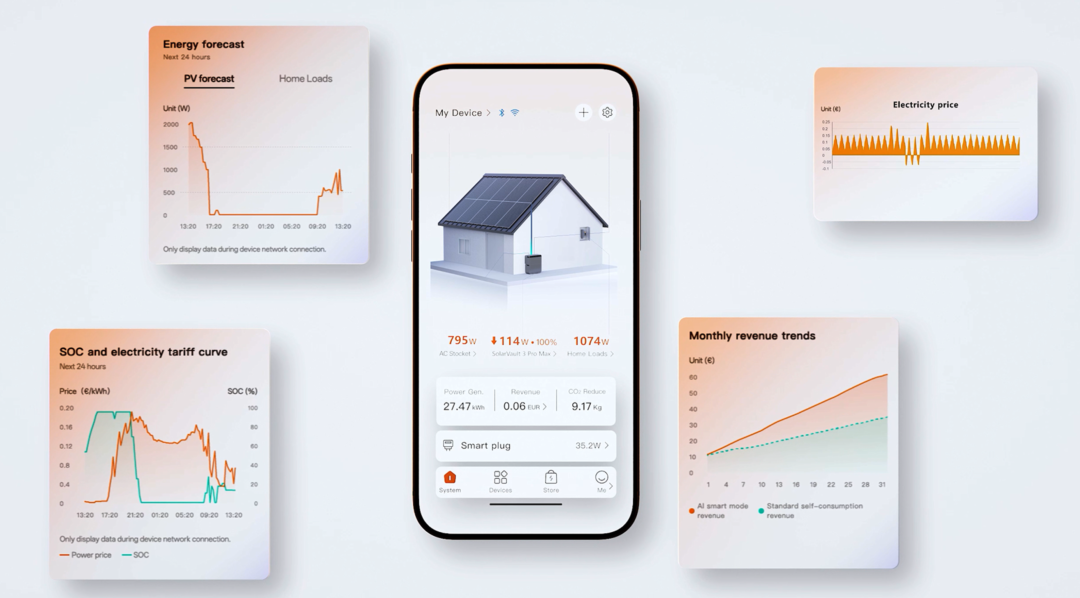
Its explainable AI design stands out as its most user-centric feature. A widespread flaw plaguing many automated systems is opacity: users cannot comprehend the rationale behind AI-driven actions. For residential customers, this lack of transparency breeds unease—energy systems directly impact electricity expenditures and power safety, and users are unwilling to cede all decision-making authority to an incomprehensible "black box".
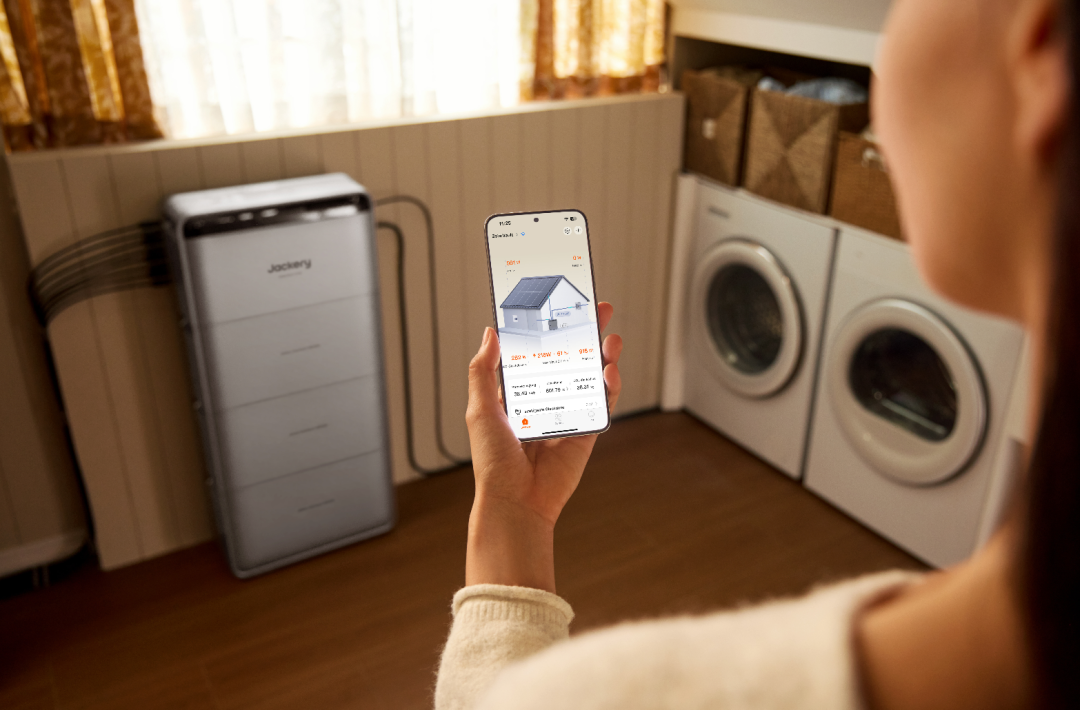
Jackery Ark AI EMS avoids this opaque "black box" model entirely. Beyond executing operational decisions, it provides clear reasoning for every action to users and technical service teams—for instance, why the battery is charging at the current moment, why it is discharging, and what supporting data underpins each choice. All relevant data is visualized comprehensively within the Jackery mobile app.
While this may appear to be merely an upgrade to user interface functionality, Jackery's core objective is to build user trust in AI-powered energy systems. The company envisions mainstream AI energy management platforms of the future as not only intelligent calculators, but transparent systems that let users fully understand every automated decision, with all operations standardized and traceable.
03 Jackery SolarVault 3 Stores Power; Jackery Ark AI EMS Maximizes Its Value
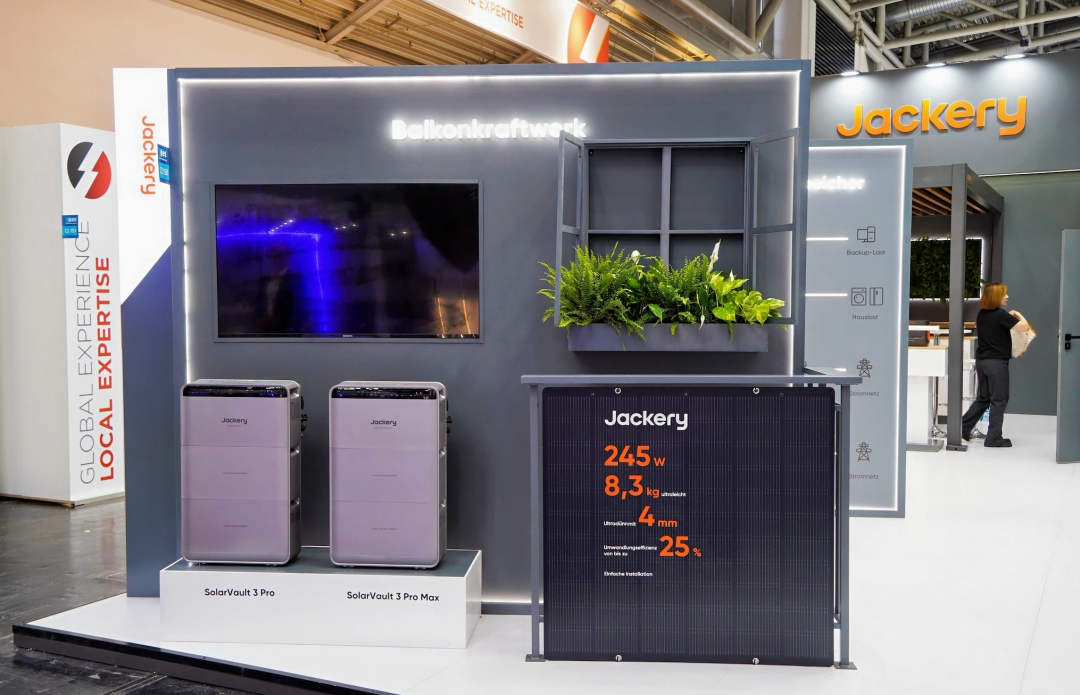
Intelligent software requires robust hardware infrastructure to deliver on its potential. On the exhibition floor, the Jackery Ark AI EMS operates in seamless tandem with the brand's new generation of yard and balcony photovoltaic energy storage product line—the Jackery SolarVault 3 Series.
In terms of hardware specifications, the Jackery SolarVault 3 supports a maximum PV input of 4,000 W with four independent MPPT channels, and offers scalable capacities ranging from 2.52 kWh to 15.12 kWh, covering nearly all residential scenarios from apartments to detached single-family homes.
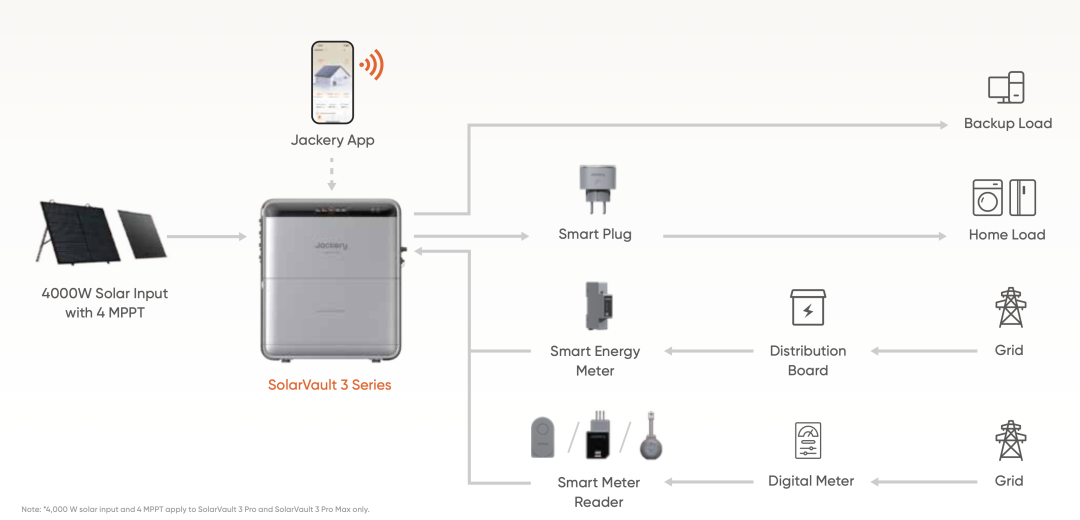
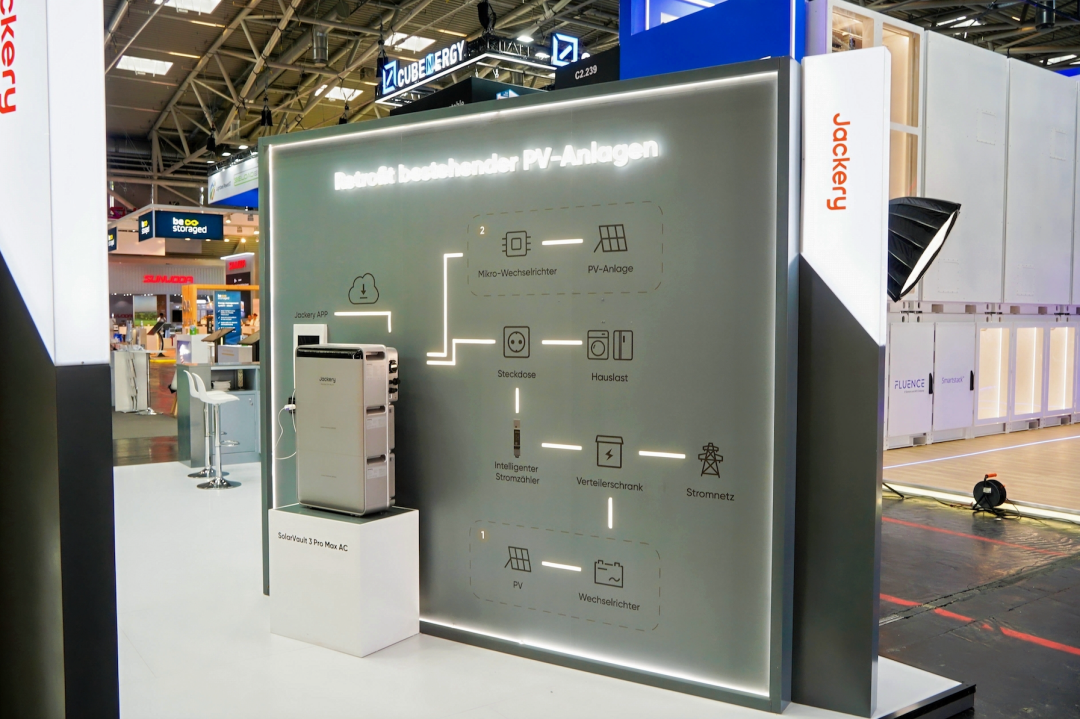
Beyond raw technical parameters, its AC-coupled architecture merits particular attention. Europe boasts a massive installed base of pre-existing residential photovoltaic systems. As net metering incentives gradually phase out, growing numbers of homeowners seek to add energy storage. Conventional storage solutions often require full overhauls of original PV infrastructure, yet the Jackery SolarVault 3 can be retrofitted to existing solar setups without structural modifications, making it highly suited for the sizable retrofit market. Additionally, the system features LFP battery cells, terminal temperature monitoring, an aerosol fire suppression system, and an IP65 ingress protection rating, enabling stable operation across temperatures ranging from -20°C to 55°C.
Jackery SolarVault 3 handles power generation and storage, while Jackery Ark AI EMS determines the most valuable ways to deploy stored electricity. Combined, the integrated system transcends basic energy storage to deliver intelligent energy optimization.
04 The Company's Ambition Extends Far Beyond Energy Storage Hardware
After reviewing the full product launch, the transformative significance of Jackery Ark AI EMS extends well beyond the product itself—it signals the brand's long-term strategic roadmap. Traditionally, Jackery is synonymous with portable power stations. Yet the brand has steadily expanded its product portfolio into a complete consumer photovoltaic energy storage ecosystem in recent years.
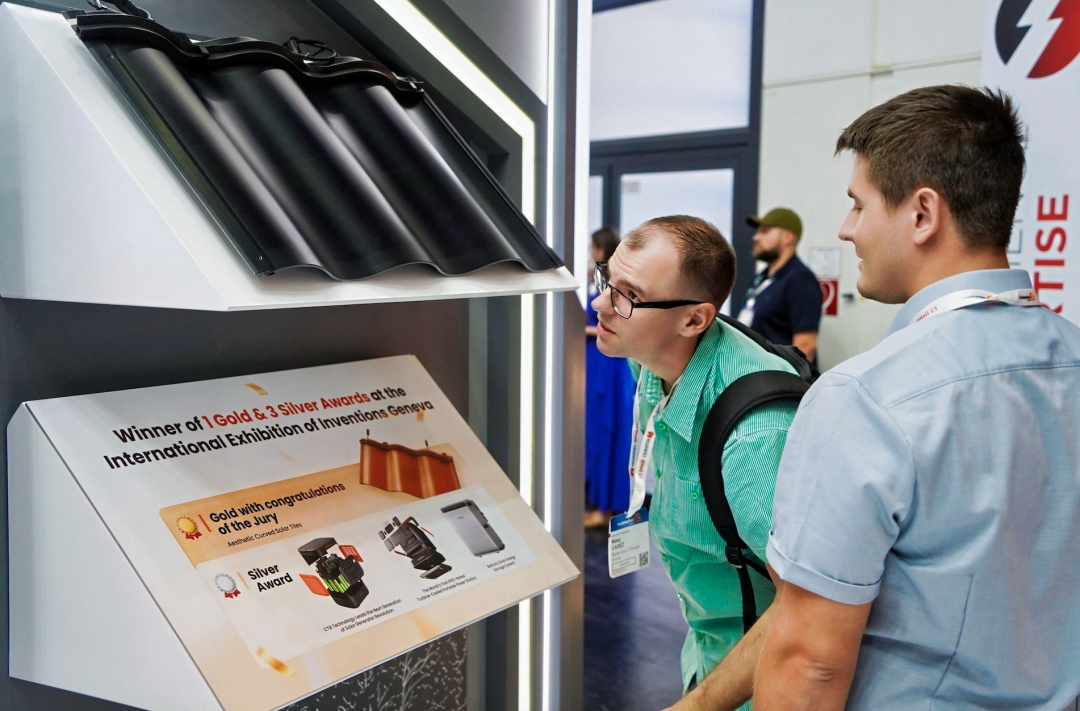
Its hardware lineup now spans portable energy storage, balcony and yard storage, full residential storage, and aesthetic curved solar roof tiles. Jackery Ark AI EMS serves as the unified core platform interconnecting all these devices. Driven by aligned policy tailwinds across key global markets—including surging residential PV installations in Europe and legalization of balcony storage in the Americas—households are evolving from passive energy consumers to active grid participants. The platform will integrate heat pumps, EV chargers, HVAC systems, and an expanding suite of household energy devices in the future, with planned connectivity to virtual power plants and broader energy service ecosystems. As homes accumulate more energy hardware, users will no longer demand additional standalone devices; they will require a unified platform to manage their entire energy asset portfolio.
#IntersolarEurope2026 #BESS #EnergyStorage #HomeEnergy #ResidentialStorage #homebattery #EMS #energyplanet
Featured News
All News →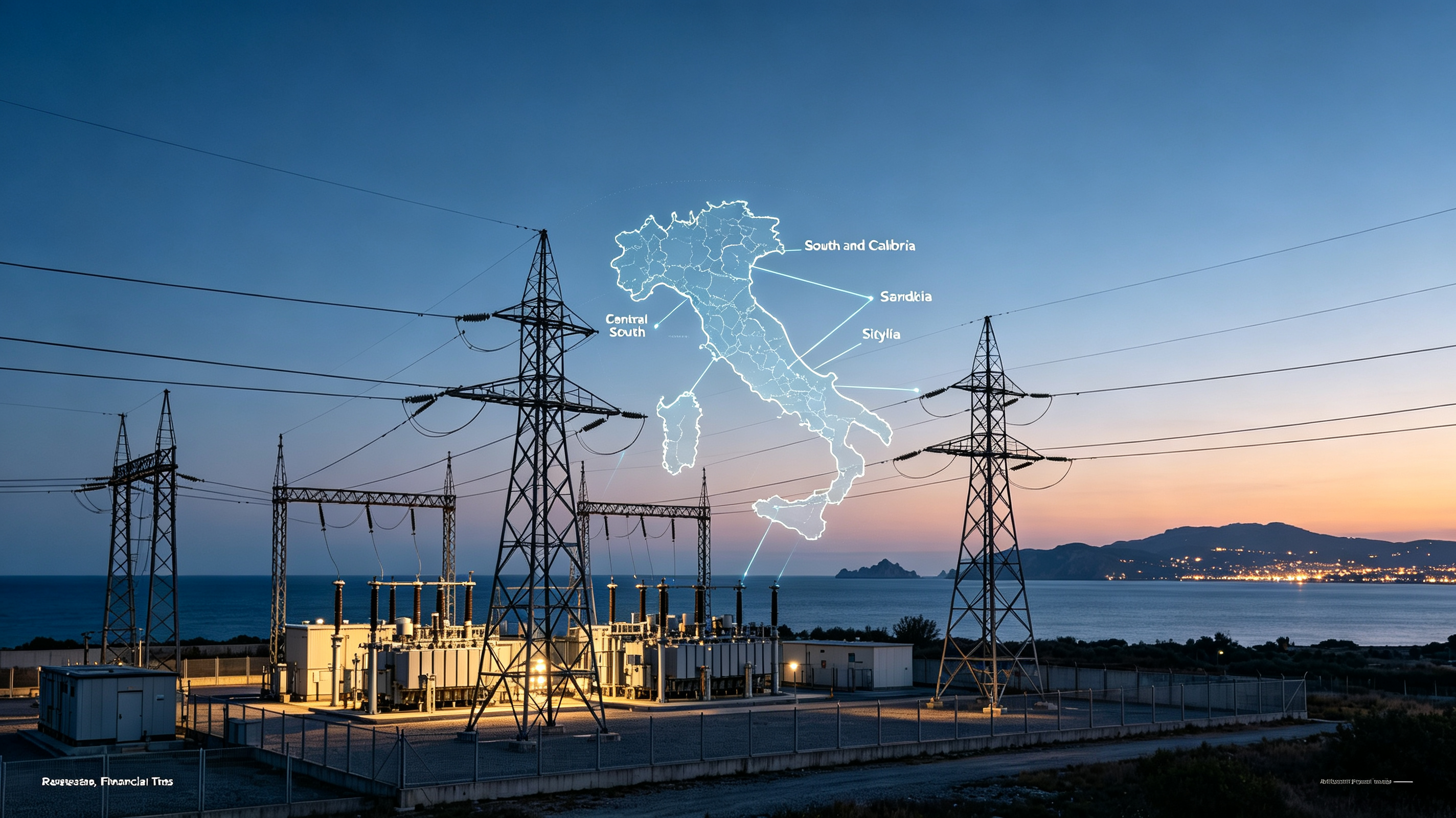
Italy Opens 16GWh Storage Auction Today as Second MACSE Round Expands by 60%
Italy will open its second MACSE energy storage auction on 24 November, procuring up to 16GWh of capacity from new projects scheduled for delivery in 2029. Compared with the first auction, procurement volume has increased by 60%, while the maximum permitted bid has been reduced from €37,000/MWh/year to €27,000/MWh/year. The results will provide a new indication of competition, regional deployment and current cost levels in Italy's energy storage market.

The Real Test Comes When the Grid Goes Down: 1,000 Witness MWh-Scale Diesel–Battery Microgrid Demonstration
A live MWh-scale demonstration at Sungrow GEPS 2026 showcased how battery storage, diesel generation and grid-forming technology can work together to deliver reliable power in off-grid applications. ENERGY PLANET joined the event to explore the technical highlights and their implications for future C&I energy storage projects.

Tesla Launches 7.4MW Powercore: Connecting Batteries Directly to the 34.5kV Grid and Medium Voltage to 800V Data Centres
Tesla has launched Powercore, a solid-state medium-voltage platform integrating transformer, bidirectional inverter and circuit-breaker functions. Rated at 7.4MW, it connects 800V–2,000V DC systems with 10kV–34.5kV AC networks, targeting battery storage, solar and 800V AI data centres. The first units are scheduled to operate in 2027, although Tesla has not disclosed pricing, customers or initial projects.
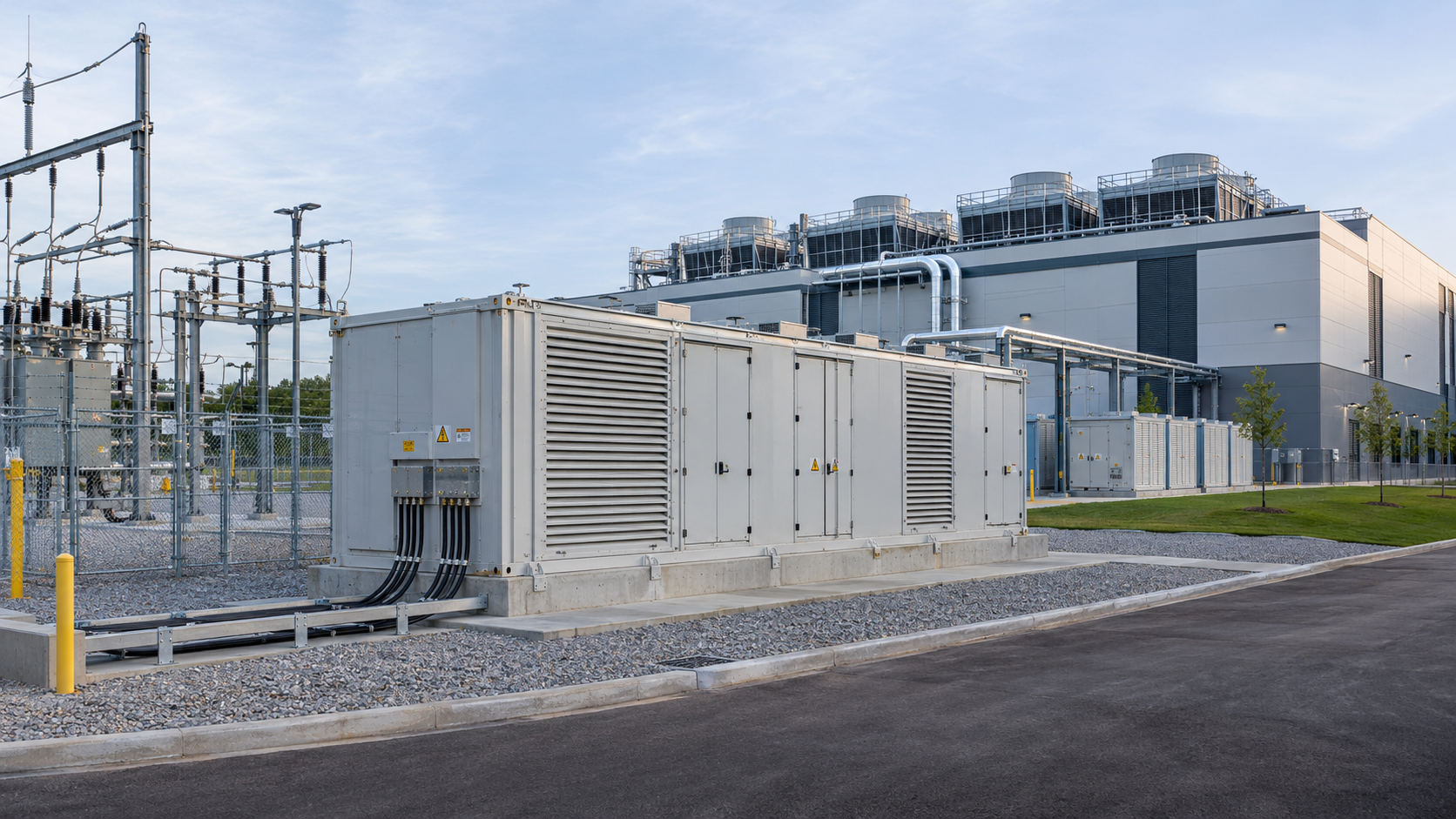
UPS Moves to the Grid Edge as Vertiv Launches 3 MVA Medium-Voltage System
Vertiv has launched the 3 MVA PowerNexus MV UPS, moving UPS functionality from the indoor low-voltage side to the outdoor 34.5kV grid connection point. Designed for new and expanding AI data centres, the system integrates fault ride-through, AI load smoothing, power-quality control and one-to-four-hour battery backup. Following a proof-of-concept demonstration in Bologna, commercial shipments are expected to begin in mid-2027.

Envision Gen 8 Selected for 442 MWh Grid Forming BESS in Germany Taking Partnership Close to 600 MWh
Envision Energy and German storage developer ju:niz Energy are advancing the 442 MWh Smareg 13 project in Bavaria. The four-hour, grid-forming development is planned next to the operational Smareg 12 site, while public records currently show a 100 MW/401 MWh configuration and a March 2028 target date.

CATL Delivers First 8-Hour EnerQB Systems for Quinbrook's 24GWh Australian Pipeline
CATL and Quinbrook Infrastructure Partners have completed production and delivery of the first EnerQB long-duration energy storage systems. Designed for eight-hour discharge, the initial units will undergo a 12-month trial at Stanwell Power Station in Queensland, Australia. Quinbrook has identified a potential 3GW/24GWh project pipeline, although wider deployment will depend on trial results, financing, grid connections and subsequent procurement.

1.24GWh! Sungrow Supplies Europe's Largest Operational Energy Storage Project
BW ESS’s Hams Hall project in the UK has officially brought its first phase online, with 350MW/1.243GWh of capacity, making it the largest operational battery storage project in Europe. Sungrow supplied the BESS, with Energy-IO and other partners involved in project delivery. The project also secured a 10-year optimisation agreement with EDF, debt financing from international banks and equity investment from AIP, highlighting the full value chain behind Europe’s GWh-scale storage projects, from equipment supply and project delivery to commercial operations and financing.

BNEF's Q4 Energy Storage Tier 1 List Shrinks 26% to 50 Manufacturers
BloombergNEF has named 50 manufacturers to its Q4 2026 Tier 1 Energy Storage list. Based on publicly available company disclosures, Energy Planet has confirmed 19 of the manufacturers and compiled historical inclusion records for 12 of them. While a single appearance shows that a supplier met the criteria for that quarter, repeat inclusion offers a stronger indication of its ability to maintain a pipeline of qualifying projects. Tier 1 remains a measure of market adoption, however, rather than a product-quality ranking, corporate credit rating or substitute for project-level technical and financial due diligence.