On September 21, NVIDIA launched a new AI infrastructure qualification program. This time, NVIDIA is looking beyond GPUs and servers, bringing the power and cooling equipment behind AI data centers into its qualification system as well. The first products included in the DSX Ready qualification scope fall into two categories: battery energy storage systems and coolant distribution units.
What Is DSX Ready: A "Selection Pass" for AI Factories
DSX Ready is not a broad "certification" for an entire company, but a qualification program for specific products or solutions. Its requirements are based on the relevant specifications in NVIDIA's DSX AI Factory reference design. In other words, even if one product from a company enters the DSX Ready program, it does not mean that all of the company's energy storage or cooling products have received the same qualification.
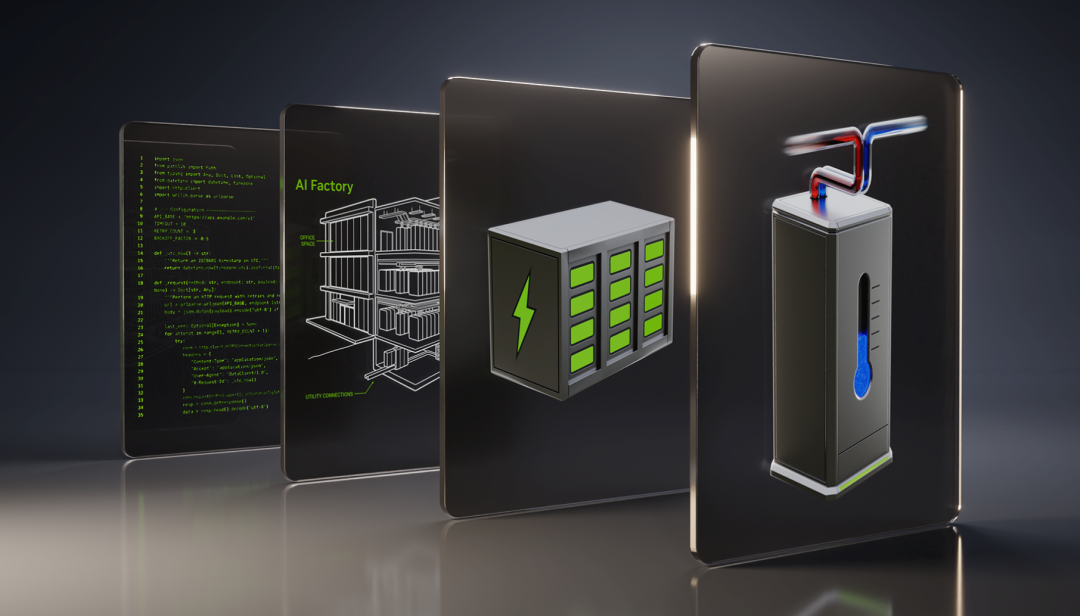
In this announcement, NVIDIA noted that an AI Factory is not built from computing equipment alone. Computing, networking, power, cooling, facilities, and software need to be designed and operated as an integrated system. Simply adding more GPUs does not mean an AI data center can operate reliably. If the power system cannot handle rapid changes in AI workloads, or if the liquid cooling system cannot match the requirements of high-power racks, even the most advanced computing equipment may still be constrained by infrastructure.
The Qualification Is Not Mainly About How Large the Energy Storage System Is
According to NVIDIA's energy storage qualification guidelines, DSX Ready does not use storage capacity, cell chemistry, or DC-side topology as its core evaluation criteria. Instead, it focuses more on whether the energy storage system can respond quickly, stably, and controllably when AI workloads and grid conditions change rapidly.
The main application scenarios highlighted by NVIDIA include:
- Low-voltage ride-through: minimizing interruption to IT loads during grid voltage disturbances
- AI workload fluctuation buffering: responding to rapid power ramps caused by AI workloads and reducing stress on the grid and power supply side
- Demand response: reducing peak grid consumption according to commands without affecting critical load protection
- Grid-connected / islanded switching: enabling smooth transitions between the grid and on-site power sources to reduce the risk of outages
- Black start: helping restore bus voltage and frequency after a complete system outage
NVIDIA Is Mainly Looking at the Dynamic Capability of the PCS
It is worth noting that the DSX Ready qualification boundary for energy storage systems is set at the AC side of the system, including the PCS. NVIDIA requires applicants to demonstrate that the energy storage system can provide dynamic active and reactive power response, current limiting, low-voltage ride-through, islanded stability, black start, and seamless switching capabilities, while also submitting telemetry, control, and test data for review. In other words, what NVIDIA is focusing on is whether the PCS and control system can behave as expected under complex operating conditions.
As for whether the system uses LFP or another cell chemistry, or whether it adopts one large DC block or multiple smaller DC blocks, these are not the main focus of the qualification. NVIDIA clearly states that cell chemistry and DC-side topology are product design choices made by the manufacturer, while DSX Ready mainly evaluates system response performance on the AC side.
First List: Three Energy Storage Providers and Three Liquid Cooling Providers
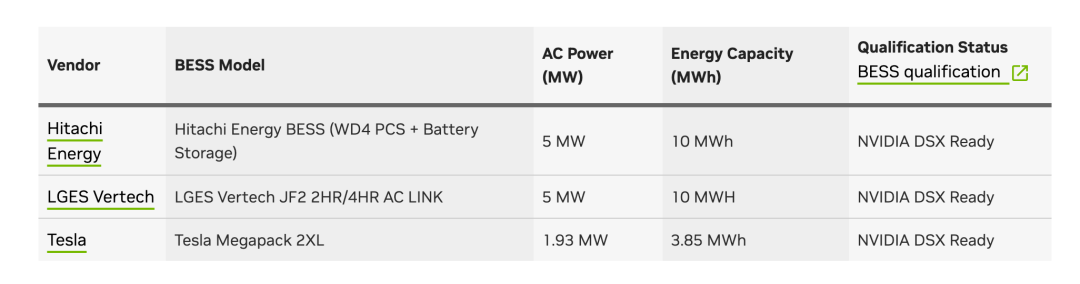
The first energy storage solutions to receive DSX Ready qualification come from:
- Hitachi Energy
- LG Energy Solution
- Tesla
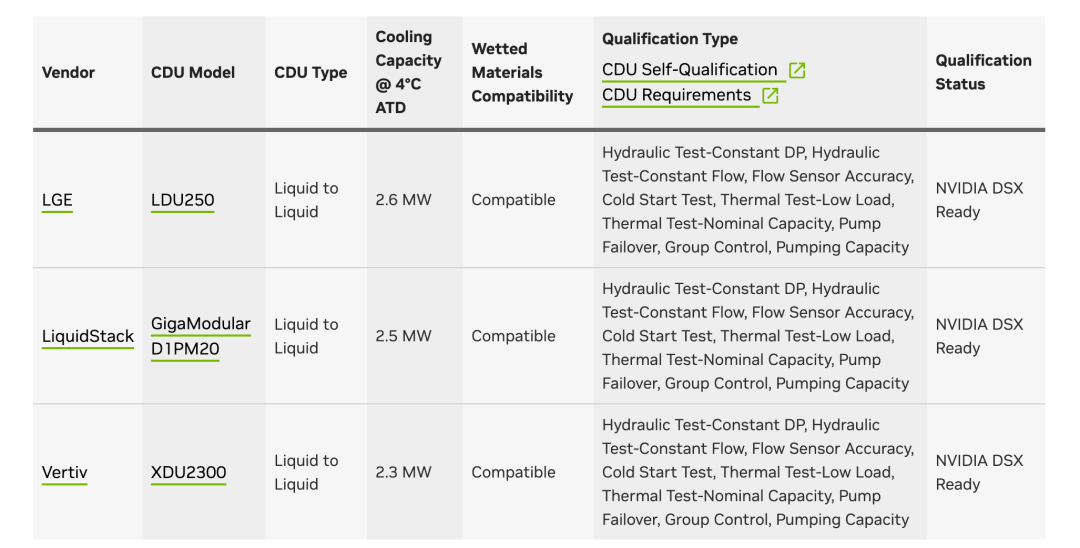
The first coolant distribution unit solutions to receive DSX Ready qualification come from:
- LG Electronics
- LiquidStack
- Vertiv
At present, no Chinese companies appear in the first group of solutions published on NVIDIA's official blog. NVIDIA also stated that more infrastructure and software categories will gradually be added to DSX Ready in the future. Energy storage and coolant distribution units are only the first step in this AI Factory qualification system.
What Do Companies Need to Do to Obtain DSX Ready Qualification?
The specific technical paths for the two categories are not exactly the same, but the overall process is already relatively clear.
First, companies need to review NVIDIA's qualification requirements for the relevant category and determine whether their products are likely to meet the corresponding requirements in the DSX reference design. They then communicate with NVIDIA's team and submit basic information about the company, the product, and the category for which qualification is being sought.
For energy storage manufacturers, the required tests must be completed within NVIDIA's specified qualification boundary. Companies then need to prepare test results, control and telemetry data, quality and reliability documentation, and other supporting materials for NVIDIA's review. For CDU manufacturers, NVIDIA provides a CDU self-qualification kit that is used to verify whether a specific product meets the relevant functional requirements.
After receiving the application and supporting materials, NVIDIA reviews them according to the product category and qualification scope. Once approved, the specific product or solution will be listed on NVIDIA Marketplace, and the company will be able to use the DSX Ready qualification mark externally.
It is important to note that DSX Ready does not replace project-level engineering design. NVIDIA clearly states that an energy storage system passing the qualification does not mean that a specific project has already achieved site-level stability. Transformers, switchgear, protection relays, generators, and campus-level control systems still need to be designed and validated separately at the project level.
Similarly, a coolant distribution unit that has passed DSX Ready qualification only demonstrates that it meets the relevant cooling requirements. Whether it is suitable for a specific data center still depends on the facility design, system configuration, and actual operating conditions.
For energy storage companies, the threshold for entering the AIDC supply chain is also changing. Having batteries, PCS, and system integration capabilities may no longer be enough. In the future, companies will also need to prove whether their systems can adapt to the load characteristics of AI workloads, participate in site-level power regulation, and form a more stable integrated system together with GPU clusters, liquid cooling systems, and on-site power infrastructure.