Just in the past few days, LONGi and Enexus announced the signing of a 50 MWh liquid-cooled BESS supply agreement. The storage systems will be deployed across two solar-plus-storage projects in the Titu area of Dâmbovița County, Romania. Since 2025, Enexus projects have already deployed more than 200 MW of LONGi PV modules, but this is the first time Enexus has adopted LONGi energy storage products within its project portfolio. For LONGi, this is also one of its larger BESS projects to date in Romania.
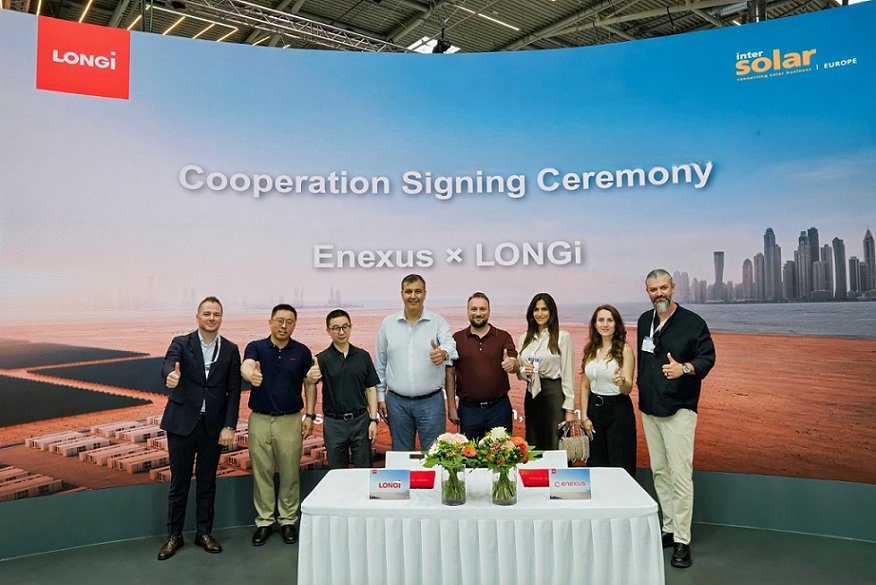
The 50 MWh order is split across two Titu projects
This agreement does not cover a single standalone project, but two separate solar-plus-storage projects in the Titu area.
· Titu 1 is located in Titu, Dâmbovița County, with a capacity of 20 MWp solar + 15 MWh BESS. It is being developed jointly by Enexus and Akış Enerji, with Enexus also serving as the EPC contractor. The project includes a 20 MVA transformer station and has completed construction, with grid connection still pending.
· Titu 3 is also located in Titu, with a capacity of 35 MWp solar + 35 MWh BESS. It is being developed by Enexus for FTZ Group and is still under development. The storage systems for both projects will be supplied by LONGi and will use liquid-cooled BESS technology together with integrated MV skid solutions.
Together, the two projects make up the full 50 MWh order, for which LONGi will supply 10 utility-scale liquid-cooled BESS units along with integrated medium-voltage systems. Based on the applications disclosed by LONGi, the systems will be used for energy shifting, smoothing renewable output and grid support, which fits well with the projects’ broader dispatchability and grid-friendliness requirements.
At the technical level, the liquid-cooling design is intended to maintain more uniform cell temperatures, reduce equipment degradation and extend overall system lifetime. The systems also use factory pre-assembled medium-voltage skid container designs, which can reduce balance-of-plant (BOP) costs, shorten on-site installation and commissioning time, accelerate project delivery, and support faster response to grid load fluctuations.
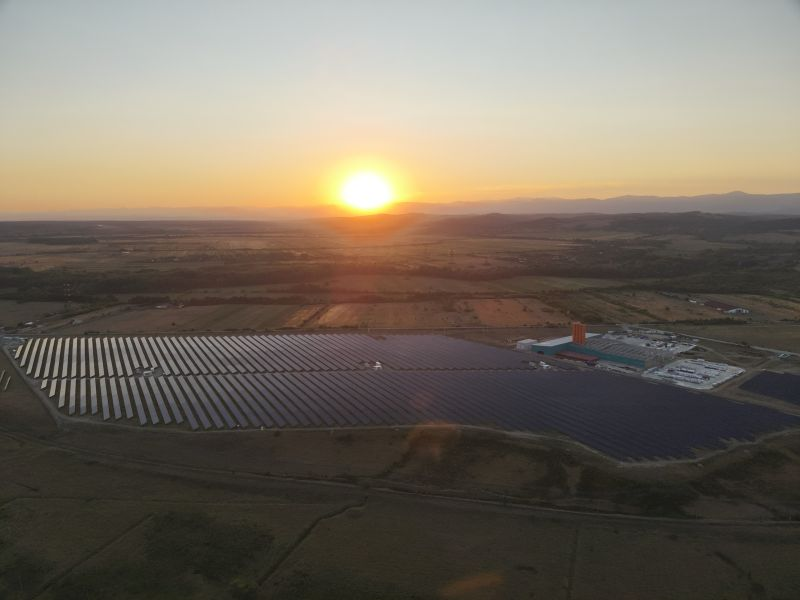
LONGi is showing up in Romania more and more often
We often look at LONGi’s project pipeline in Romania to judge how active it is in the market, but this time we also wanted to look at it from a media perspective. Over the past year, while ENERGY PLANET has been discussing cooperation with a number of overseas renewable-energy summits and forums, LONGi has repeatedly appeared in their event promotion packages.
That includes the Romanian Renewable Energy Summit 2026 taking place today, as well as this spring’s Solar Energy Bucharest Summit and Romanian Solar Summit. LONGi has frequently participated as a Premium Partner in local discussions around solar project development, EPC delivery, storage integration, storage safety and system operation. The focus of these events is also gradually shifting away from project construction alone toward grid connection, financing, utility-scale solar development, and the role of BESS in overall project design — including business models, revenue streams, grid support and long-term operations and maintenance.
This kind of repeated market exposure says quite a lot. It is not unusual for an equipment supplier to attend a single exhibition, but when a company repeatedly enters the same market’s discussions around solar, storage, safety, financing and project development, it suggests that the goal is no longer simply to sell equipment, but to become part of the broader local industry ecosystem.
That market investment is also starting to line up with real projects. LONGi has already worked with Nofar Energy on the 282 MW Corbii Mari solar project in Romania; it later expanded its European cooperation with Enery, bringing large hybrid projects in Romania into its portfolio. The Enery partnership is another example. With the addition of Enexus’s 50 MWh BESS project, LONGi’s local project path is becoming more complete.
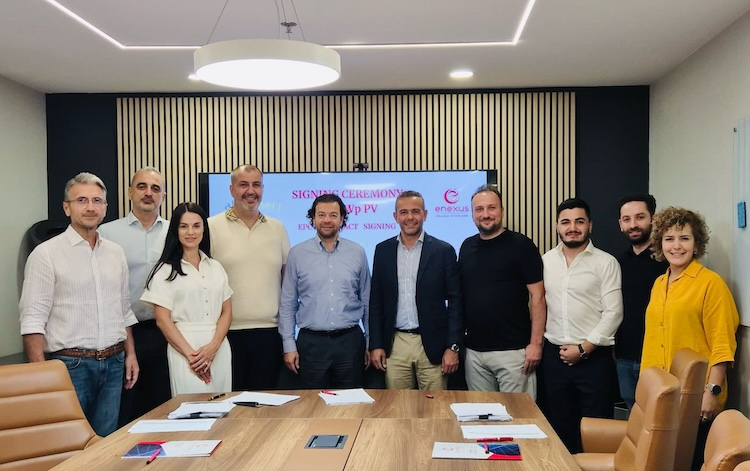
Why Romania is in a particularly interesting window right now
LONGi’s continued investment in Romania is not only about the growing number of renewable-energy projects. More importantly, Romania is now providing energy storage with clear policy and financial support.
In March this year, the European Commission approved a €150 million Romanian state-aid scheme for electricity storage, equivalent to roughly RON 764 million. The scheme specifically supports new electricity storage facilities and targets at least 2,174 MWh of new storage capacity. In other words, this round of support alone is tied to more than 2 GWh of targeted storage additions, showing that Romania’s support for BESS is moving from broad policy direction into actual funding allocation.
And that is not the only source of funding. Romania is also a major beneficiary of the EU Modernisation Fund, where energy storage itself is one of the explicitly supported priority investment areas. European Commission information shows that, under the 2021–2030 framework, Romania holds a relatively large share among beneficiary countries, while storage, grid upgrades and power-system flexibility all fall within eligible investment areas.
Policy support is already showing up in deployment data. According to Transelectrica, as of April 1, 2026, Romania had 599 MW / 1,129.7 MWh of operational energy storage. Compared with a market that until recently was still dominated by projects in the hundreds-of-megawatt-hour range, cumulative capacity has now passed the 1 GWh mark and is still rising.
At the same time, grid-connection rules are also changing. In 2026, Transelectrica formally launched an auction-based grid-capacity allocation mechanism and completed its first application round from July 1 to 14. Transelectrica capacity allocation platform For storage developers, this means grid access is moving away from a relatively static application process toward a more transparent, but also more competitive, capacity-allocation model.
On one hand, this mechanism raises the development threshold; on the other, it also helps filter out projects that hold grid capacity for long periods without moving forward. For storage projects with real financing, EPC capability and an established equipment supply chain, the market could actually become easier to navigate once weaker projects are screened out. That is also why suppliers such as LONGi are accelerating their entry at this stage.
Sources:
· LONGi — Enexus 50 MWh BESS agreement
· GOVNET Romania — Titu 1 project background
· LONGi — Nofar Energy / Corbii Mari
· LONGi — Enery partnership
· European Commission — €150m storage aid scheme
· European Commission — Modernisation Fund
· Transelectrica — Q1 2026 report
· Transelectrica — Capacity allocation platform