The UK has recently launched an interesting initiative: the Ultra-Long Duration Energy Storage Challenge. UK Research and Innovation (UKRI) is providing £28 million in funding to support the development of energy storage technologies capable of supplying power continuously for 100 hours or more.
To achieve continuous energy supply of more than 100 hours, the UK is not betting on just one technology. Instead, it is supporting two directions at the same time.
• Advanced electrochemical energy storage technologies: The UK aims to develop new battery technologies capable of providing power for more than 100 hours. According to UKRI, these technologies have not yet been commercialised at scale, so the focus at this stage is to continue validating their technical, engineering and cost feasibility.
• Underground hydrogen storage: The programme will also support the development and testing of systems that store hydrogen underground and release it when needed.
So, the £28 million is not simply being used to purchase existing 100-hour storage systems. The UK wants to use R&D support to identify which technologies can genuinely provide continuous multi-day energy supply while remaining economically viable.

100 Hours of Continuous Discharge — and a 25-Year Operating Life
A specific funding round has already opened for the electrochemical energy storage track. As part of the wider programme, the UK has allocated up to £3 million to support project development studies for electrochemical ultra-long duration energy storage technologies.
Applications opened on 3 August 2026 and will close at 11:00 am UK time on 30 September 2026.
The funding round has a clear domestic focus. UK-registered businesses can apply independently or lead a consortium, regardless of company size. Organisations receiving funding must carry out the project work in the UK, intend to exploit the results in the UK, and spend most of the funding within the UK.
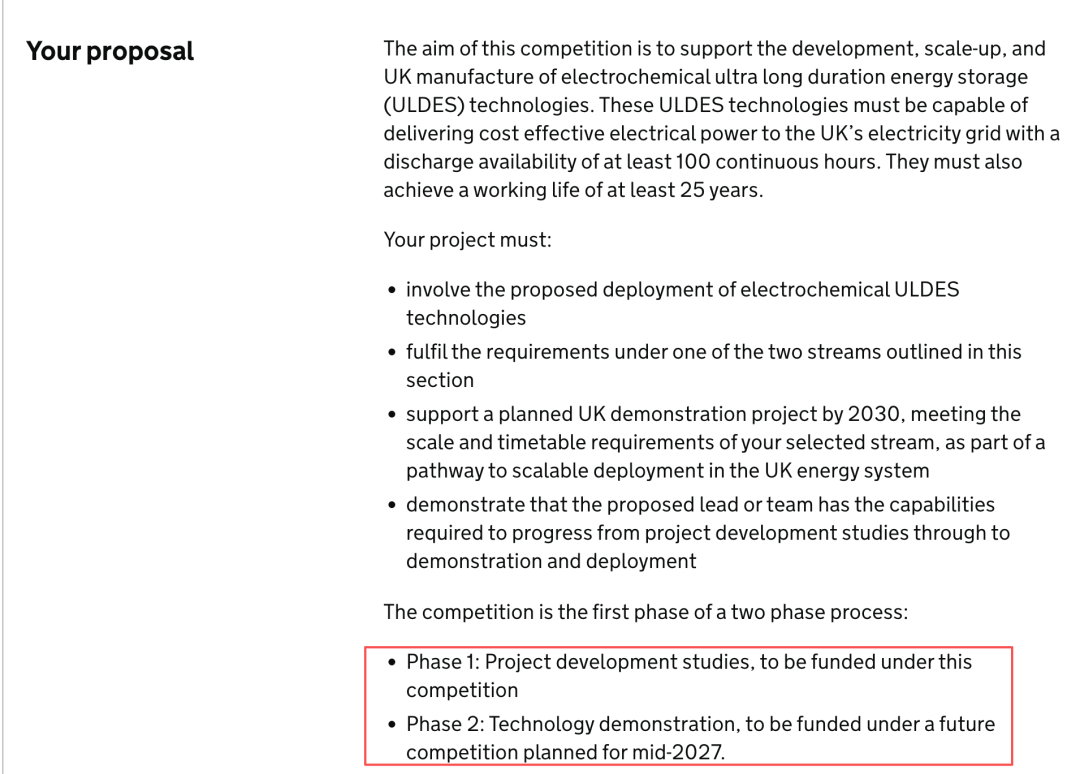
According to the competition requirements, eligible technologies must be capable of providing at least 100 continuous hours of discharge and must achieve a working life of at least 25 years.
Individual projects can request between £350,000 and £700,000 in grant funding. Applicants must also provide a technology assessment, engineering design, cost and scale-up roadmap, manufacturing and supply chain plan, as well as other project development work.
In other words, applicants need to think through not only how the system will be built, but also how costs can be reduced and how production can eventually be scaled. That is also the purpose of this funding round: to strengthen project proposals before moving toward larger-scale demonstration projects.

First Develop the Project, Then Build Large-Scale Demonstrators
The electrochemical energy storage track is being advanced through a two-phase approach.
Phase 1 focuses on project development studies. Under the current plan, Phase 2 is scheduled to launch in mid-2027, with at least £10 million allocated to support the development and delivery of large-scale ultra-long duration energy storage demonstrators.
However, Phase 2 remains a planned programme at this stage, and detailed application requirements and implementation rules are still to be announced.
UKRI has also set a longer-term ambition to support one to two demonstrators above 100 MWh by 2030, with the goal of achieving GWh-scale grid deployment by 2035.
Official Funding Entry
The currently open competition is the £3 million Electrochemical Ultra-Long Duration Energy Storage Phase 1 competition.
UKRI Official Funding Opportunity
Ultra-Long Duration Energy Storage: Project Development Studies
Direct Application Portal — UK Government Innovation Funding Service
The £28 million refers to the overall Ultra-Long Duration Energy Storage Challenge, while the currently open electrochemical Phase 1 competition provides up to £3 million in funding.